BY DASHNI ANBUARASU
Is it possible that what is known as healthy foods turn out to be the biggest health issue for some? This is the case for those with Irritable Bowel Syndrome (IBS).
IBS is a condition that causes discomfort in the digestive system and the reason is largely unknown. From diarrhoea, flatulence, constipation and pain, IBS brings different symptoms to different individuals. Fruits, vegetables, legumes, honey, milk and dairy products may be the cause of these symptoms.
These foods are rich in FODMAPs (fermentable oligo-, di-, mono-saccharides and polyols) – food containing fermentable oligo-, di-, monosaccharides, and polyols. A very high intake of FODMAPs may trigger diarrhoea, bloating and pain in patients with IBS.
The name suggests that these foods are a group of short-chained carbohydrates that are poorly absorbed in the small intestine due to a lack of enzymes. These then pass the large bowel to be fermented by gut bacteria.
[ihc-hide-content ihc_mb_type=”block” ihc_mb_who=”unreg” ihc_mb_template=”3″ ]How do FODMAPs trigger symptoms?
When people with IBS consume foods high in FODMAPs, some of the FODMAPs are mal-absorbed such as fructose (fruit sugar), lactose (milk sugar) and polyol (alcohol sugars). Fructan and galacto-oligosaccharides (GOS) are not digested due to lack of enzymes and it is usually fermented in the large bowels by gut bacteria.
This mal-absorbed FODMAPs then enter the small intestine and draw water and exert an osmotic effect causing diarrhoea. In the meantime, the other FODMAPs go through rapid fermentation by gut bacteria and accumulates gases as their by-products causing bowel distension and even constipation in some people.
What is a Low FODMAPs diet (LFD)?
The Low FODMAP diet has been shown to improve symptoms, particularly those with frequent episodes of diarrhoea. When these patients omit all foods high in FODMAPs and replace their foods with lower FODMAPs, their osmotic load is also reduced. It has been shown that 140 grams of FODMAPs can cause symptoms in IBS patients and those in a low FODMAP diet usually consume 70g or less.
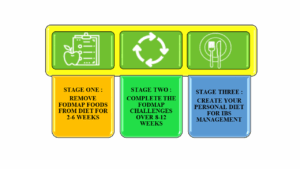
Dietary advice should only be sought from a dietitian who manages gastrointestinal patients as the diet is very restrictive. The LFD is a 3 phase diet whereby the first phase is the restriction phase, followed by a reintroduction or challenging phase, and finally, the personalization phase.
Restriction of FODMAPs is usually four to eight weeks, followed by gradual reintroduction of moderate to high FODMAPs foods so the patient will manage the type or amount of FODMAPs they can tolerate in a day and identify the type of FODMAPs that causes most of the symptoms.
In the reintroduction phase, patients are usually advised to include one food item with a single FODMAPs and increase the amount, and it is usually a 3-day challenge. i.e., patients who wish to challenge fructose will be consuming 100ml of mango juice on day one while still following a low FODMAP diet and note their symptoms.
If there are none, they will proceed to increase this amount on days two and three. If they have gastrointestinal symptoms on any day, they will need to stop the challenge and continue to be on a low FODMAPs diet for three days before moving on to another challenge.
Patients are usually advised to keep a diary to write down all the types of foods, amounts, and symptoms so this can be challenged at another time. Many patients usually would not want to rechallenge these foods and would rather be on a low FODMAPs diet once they see their symptoms improve.
This rechallenge phase takes between one to three months to complete and depends on the variety of FODMAPs the patients choose to rechallenge.
Once the rechallenge is completed, the patient will then move on to their personalisation phase. They will continue with their daily diet by including high FODMAPs foods in their meal that do not trigger symptoms. If a patient has symptoms at any point, they will then go back and rechallenge this by following the three-day challenge.
Efficacy of Low FODMAP diet in IBS
Up to 86% of patients with IBS find improvement in overall gastrointestinal symptoms as well as individual symptoms such as abdominal pain, bloating, constipation, diarrhoea, abdominal distention, and flatulence following the Low FODMAPs diet.
The FODMAP diet is well established in its efficacy for managing symptoms of IBS, but with increasing popularity comes controversies and inappropriate application of the diet. Some potential limitations and concerns of LFDs have been raised, such as nutritional adequacy, cost, and difficulty in teaching, learning, and continuing the diet.
Most of these problems are amplified in patients who follow the diet without clear professional advice. These can be easily resolved with the presence of a skilled dietitian who can explain the different phases of LFD and ensure nutritional adequacy and the patient’s compliance.
Moreover, it would be desirable to improve the food analysis regarding FODMAPs content while considering the varied eating habits of different populations in different countries. Most negative attention for the FODMAPs diet has been the notion that it will ruin the microbiota. Controlled studies have indicated that a low FODMAPs diet reduces total bacterial count and gas production with little effect on colonic volume.
Hence, it is important that people do not take IBS symptoms lightly and start discovering FODMAPs diet in order to identify the “certain” food that actually mess up their gastrointestinal health.[/ihc-hide-content]