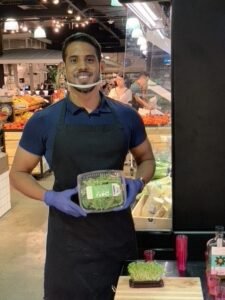
WITH the advent of issues like climate change, decreasing arable lands, and a rapidly growing population, how does one plan to ensure food security without incurring additional costs to businesses and the environment? Stuart Thomas, 26, sees a solution to that problem in his enterprise, Babylon Vertical Farms.
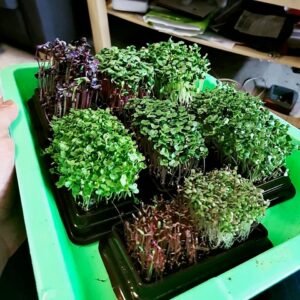
Operating out of a 320 ft2 shipping container nestled within a quiet neighbourhood in Ampang, Stuart and his team grow and produce healthy, farm-fresh, and pesticide-free vegetables for high-end restaurants and grocery chains in the Klang Valley. Using a vertical hydroponic system, Babylon Vertical Farms can produce about [ihc-hide-content ihc_mb_type=”show” ihc_mb_who=”2,3,5″ ihc_mb_template=”1″ ]15-20kg of kale a month, alongside commercial boxes of microgreens and herbs such as amaranth, mizuna, coriander, and basil.
“Growing plants indoors where you can monitor and control the parameters needed for optimum growth means that we can produce consistent yields of fresh and high-quality greens year-round,” says Stuart, the founder and CEO of Babylon Vertical Farms.
Having a vertical farm right in the middle of Kuala Lumpur has many advantages. The cost, time, and resources used for transporting the choicest vegetables to clients are drastically reduced, as they don’t have to import them from conventional farms outside the city. Stuart claims that they can deliver their produce from harvest to plate in about six hours, compared to the industry average of 18 hours. Shortening the travel distance from farm to clients not only preserves the freshness of the produce, but also reduces the carbon emissions from transportation, which is one of many elements of environmental sustainability vertical farming provides.
Sowing the seeds of an idea
Stuart was introduced to vertical farming when he was idly scrolling through social media during class and stumbled upon an article which featured it as one of the major industries projected to flourish in the near future. Stuart saw the potential it had in contributing to Malaysia’s agriculture industry and addressing the issue of food security. “I saw this venture as a necessity – I knew I wanted to involve myself in a business which could help boost Malaysian agriculture,” Stuart said. Citing the Covid-19 pandemic as an example, he observed that when major events afflict countries, multiple industries suffer and the economy is badly affected. “For the agriculture industry, I see vertical farming as a solution that is proactive instead of reactive, and we should have contingencies placed to curb any potential economical crises. Plants grown indoors are not affected by any external environmental factors, and we can produce a consistent yield of crops no matter the circumstances happening outside,” Stuart said.
Venturing into this field, his team comprised four friends with no agricultural or botanical background. They had applied for the accelerator programme to develop social enterprises at the Malaysian Global Innovation & Creativity Centre (MaGIC) in Cyberjaya, and successfully landed themselves a RM 30, 000 grant to turn their vertical farming idea into a reality. Despite having no prior knowledge in plant cultivation, the boys were determined and performed a lot of field tests to determine the best approach in every facet of their farming method – from the light source to the watering system to even the vertical support tower to plant their seedlings. As Stuart asserts, “a little technical knowledge goes a long way”.
Optimising yields through efficient practices
“We’re able to optimise our yields which are consistent in quality and freshness because they’re unaffected by rain or shine, and we maintain a climate-controlled environment and use 24-hour LED lights”, Stuart explains on how his team care for their plants. As their objective is also to promote sustainable practices in urban agriculture, they’ve utilised several methods and energy sources that come with a low environmental cost. As their farm does not rely on soil as a growth medium, they are able to cultivate their produce without the need for fertilisers. Stuart has also opted for UV lighting instead of pesticides to disinfect and remove pesky bacteria from affecting his plants. Water efficiency is also maximised through their hydroponic system which employs reverse osmosis to water their plants, an effort which saves water by about 95 percent compared to traditional farming. And with modified water pipes that line the perimeter of the 40 ft long shipping container, Babylon Vertical Farms is able to save valuable farming space and produce an output that is equivalent to one acre of land.
Persevering through personal struggles
While Stuart exudes a buoyant and confident vibe when sharing about his farm, he divulged that he had experienced his fair share of obstacles and negative perceptions from people around him. “A big part of my struggle came from convincing my family and turning a deaf ear to the naysayers. I knew in my heart that building this solution was necessary and I wasn’t going to listen to anyone who put their own needs above a bigger cause,” he remarked.
Looking back on his journey from leaving his accountancy background to becoming an agricultural social entrepreneur, he added, “I have a diploma but I didn’t finish my degree. Most of my partners have a paper qualification. I still feel uneasy sometimes, to be honest, but I find that I learn better through experience and making mistakes. I always value purpose above self, and I will devote myself to this cause to hopefully leave the world in a better place.”
Plans in building a better farm
Currently, Babylon Vertical Farms has not reached the profit-making stage of their journey yet; they’ve set a target to reach that benchmark within the next three to five years. To achieve that goal, Stuart and his team plan to expand the farm in the near future. “We are planning a bigger farm in the latter half of the year, one that is five to eight times bigger than our current capacity right now. We want to be able to cater to more clients, and to grow our plants with better measures and designs in place,” Stuart said. The nation’s food security has always been an ultimate goal for him to work towards, and is the driving force behind his hopes to grow a bigger variety of produce and staple crops with maximum cost efficiencies.
As a youth who is now the CEO of his own social enterprise, he shares his motto which has kept his faith and energy in moving forward – “If you can do something to improve the life of one person even by a bit, then you should pursue it.” pd[/ihc-hide-content]