PETALING JAYA: There is a strong need for scientists and technopreneurs to effectively communicate their scientific and technological ideas to non-technical stakeholders.
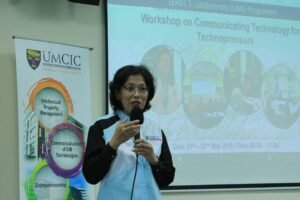
This was the key takeaway message at a two-day training workshop themed: “Communicating Technology for Technopreneurs”.
The workshop was jointly organised by the Malaysian Biotechnology Information Centre (Mabic) and University Malaya Xcelerate Programme (UMX) on May 11 and 12 at the Innovation Incubator Complex, University of Malaya.
UMX is University of Malaya’s Centre of Innovation and Commercialisation business support programme.
The content of the workshop which was developed by Mabic is the first home-grown module for science communication. It is tailored to meet the specific needs of scientists and technopreneurs.
Mabic Executive Director Dr Mahaletchumy Arujanan said it is important to have local experts as resource persons as they would know local priorities, concerns, cultures and sensitivities better than foreign experts.
[ihc-hide-content ihc_mb_type=”show” ihc_mb_who=”2,3″ ihc_mb_template=”1″ ]“This is really important for scientists and technopreneurs who have to frame and create messages effectively when communicating with their stakeholders,” she added.
Prof Rofina Yasmin Othman who is director of UMCIC said: “In science, communication is everything.
“Without communication, the innovations resulting from scientific research remains closed up in our laboratories when they should be transforming our society,” she said.
She also said a continuous Media collaboration between UMX and Mabic will help to build up a technopreneur ecosystem with the skillsets necessary for them.
Through her workshop dynamics, Mahaletchumy guided the participants through rules of effective communication and the importance of planning their messages, building trust with stakeholders, communicating the key messages to different stakeholders.
She noted that a non-scientific audience is more interested in knowing the impact of the research on them as opposed to the process of the research. She also emphasised that researchers need to prioritise on strategic ways to communicate their findings.
Dr Ivy Chung, a participant from University of Malaya acknowledged that effective communication is key to translating research findings into impacts in society.
She said: “As a researcher I have an obligation to communicate science
to my audience, and this workshop has made me realise it is really important for me to understand my audience so I can communicate effectively.”
Another participant from University of Malaya, Muhammad Afiq Dzulkifli said the workshop is really helpful for him in translating his work as an engineering student.
“I think that now I will be able to communicate my research effectively and I hope the skill I acquired from this workshop will help me to secure grants for my research,” he said.
The participants also acknowledged the importance of engaging with mass media alongside social media as an avenue to disseminate scientific information to the public.
Participants were also taken through role plays where they were tasked to pass a key message for a non-scientific audience using the principles and techniques learned during the training.
At the end of the workshop, the participants have also successfully produced their news article to be published by The Petri Dish.
[/ihc-hide-content]