When did you realise that origami could be more than just a hobby?
I started folding origami when I was eight, and at that time it never occurred to me that I would be where I am today – an origami scientist. I worked at this multinational company in Japan, the major origami industry of the world, for about seven and a half years. It was there that I was exposed to all the legendary origami masters and their creations. I used this as an opportunity to learn as much as possible during my stay there.
I was a senior manager in that company before returning to Malaysia in 2011, the same year the Fukushima earthquake happened. I then decided to go on a six-month observational tour to assess the local origami scene, travelling around Peninsular Malaysia to feel the local pulse on origami. I even had makeshift booths and tables at local bazaars and busy streets to teach origami for free. What I observed was – the awareness of the importance of origami usually came from foreigners, like expatriates or tourists, instead of the locals. In fact, at that time there wasn’t a single origami Malaysian icon that had been folded.

Academy PIX/Farah Nadzri
Why do you think it is important to promote origami in Malaysia? How did you come to the decision to dedicate yourself to promoting and teaching origami in Malaysia?
It was when I participated in the International Meeting on Origami in Science, Mathematics, and Education conference (OSME) in Tokyo during a sharing session with origami science pioneers I experienced a “lightbulb” moment. [ihc-hide-content ihc_mb_type=”show” ihc_mb_who=”2,3,5″ ihc_mb_template=”1″ ]
The science of folding can be applied to just about anything in the universe, from quantum level to the micro level – they all use a sequenced folding mechanism. For instance, the pattern of tucking and deploying of an insect wing like that of an earwig uses folding. Once you master origami, you can begin to understand concepts like wormholes and multidimensions. I questioned myself if I should just focus and develop myself as an origami folder, to explore all my ideas and produce unique creations, or to educate and help nurture fellow Malaysians to develop their folding skills so that their creativity can be showcased to the world? I chose the latter, and began scouting fellow origami enthusiasts in Malaysia through social media platforms. We had met up and the initial one-hour meeting turned to six hours, discussing the possibilities of how origami could take off in Malaysia and convincing those who were sceptical about the idea. From that small meeting, the ones who remained are part of the core team of the Origami Academy today. I have sacrificed a lot, leaving my permanent job, moving places, relocating my family and my children’s schools – to persuade people that there is hope for origami in Malaysia. I realised that even teaching origami itself was a critical component in building awareness, so I set my focus on the field of pedagogy and andragogy. Andragogy is geared towards adults, and I have done field tests to assess my teaching methods, like conducting workshops for groups such as the blind, autistic children, and people with learning disabilities.
What are your areas of focus right now since you began pioneering origami science in Malaysia?
I focus on the pedagogy and andragogy part of origami for teachers and instructors to use effective techniques to teach origami. It is only through having an educational program to train the trainer that we can establish an effective transmission of skills from instructor to student. I want to create a pool of educators in Malaysia, instead of just focusing on myself. As I have mentioned, I would definitely prefer to be a folder and go solo, but I would not be able to sleep well at night, knowing that I did it all for myself instead of helping others. It is my hope that I can nurture and develop talents that are able to come up with amazing creations and folding techniques, to train potential origami masters. Through my students, they can fulfil the dreams that I could not achieve. I am satisfied with coaching, and I even get satisfaction from my son’s achievements in his origami.
However, I know that I cannot pass on the teachings of origami to others on my own, which is why I’m working hard to convince some teachers to be full time origami instructors. It is better to have a synergy of ideas that stem from collaborations on how to better cultivate a passion for origami in Malaysia. However, I also know that being a fulltime origami instructor is not a financially stable career choice at present. This is another area I’m focusing on – a way to develop this business sustainably and maintain a balanced supply and demand so instructors would not need to worry about earning a living.
What are some of your concerns regarding the origami movement in Malaysia?
In terms of the global race in origami technology, it was very worrying because people
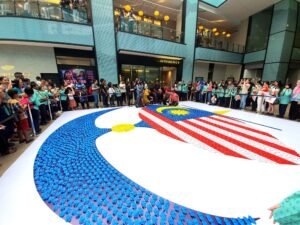
didn’t seem to realise just how much they’re far behind and how much we’re losing out. I felt very alone and stressed when I first started, as Malaysia is already a latecomer to the global origami movement and there weren’t any teaching manuals to even prepare Malaysians for it. With the entry into the Malaysian Book of Records for the first-ever origami wau bulan designed and folded by Sam Yap, it was a breakthrough and there was finally some exposure for us. Since I began, I appreciate that origami awareness has been progressing yearly. While awareness is important, ultimately, we still need an efficient and actionable plan to educate people about origami. That is my major concern right now, as every second of inaction is a step backwards in the global origami race.
What does it take to teach origami effectively? Is it different from other conventional subjects?
For origami instructors, there is an intense cognitive load placed on them because they need to be instantaneous in their teaching method. If one of the students were to make a wrong fold, the instructor needs to know how to troubleshoot immediately. They need to know which intervention strategy is better and tailor it to that particular student’s learning style; whether it’s proactive where you can guide the student before the wrong fold is performed, or reactive where you have to guide the student on the spot. The instructor needs to perform this before the wrong folding sets into the mind of the student, and deliver their guidance in a way that preserves the student’s dignity and self-esteem. Intervention strategies are especially important with students who have learning disabilities, and whether they need physical guidance where the instructor guides them step-by-step right next to them, or if they can rely on verbal guidance where the instructor simply teaches them how to undo and redo their folding just by verbal instructions. This depends on the level of the student’s psychomotor skills.
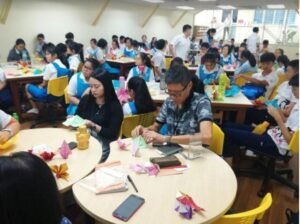
Origami instructors would also need to practise inversion since they are observing their students folding from the opposite viewpoint, and from there they need to know every possible wrong folding action to be able to guide a student having trouble immediately while maintaining the pace and attention of the other students. As I have mentioned, an origami instructor needs to be instantaneous, to know which teaching method to use to prevent any frustration or learning deterrence from not only one student, but the entire class. This is why the ratio of instructors to students is low, and the number decreases with a younger age group. The competence of an origami instructor is key and we can’t hastily implement origami lessons into our education system without first training the instructors.
What are some of the implicit skills one can gain from origami?
At a lower primary level, at about seven to nine years old, origami can help to develop the child’s geometry, spatial reasoning, and psychomotor skills. For upper primary students,

they can learn the fundamentals of robotics, and link concepts to mechanical engineering. They can also test their logical inferences, such as through abductive, deductive, and inductive reasoning.
Abductive reasoning would entail the student to link certain concepts given to them to create a best guess, while deductive reasoning involves making inferences based on premises held to be true. Inductive reasoning involves making predictions or generalisations based on tried-and-tested methods. Origami can be used as a subtle, non-threatening way to teach maths, and it can motivate or attract students to delve deeper into the mathematical concepts used.
Beyond the educational skills that you can acquire via learning origami, is there another facet to origami that most people are not aware of?
Origami is not only art or science, but can even be used as a social transformation tool. Kinesiology, the study of the mechanics of body movement and how it applies to human health, is greatly related to origami. Thus, origami can be used as a form of therapy or rehabilitative exercise for drug dependents, people with learning disorders, autism spectrum disorder, stress, and many others. It can even be used to enhance an already healthy, normal brain.
Another way origami can benefit us is by instilling a sense of nationalism. An example would be the origami crane. When people fold the crane, they associate it with Japan and their culture. The idea of Japan is deeply connected with the origami crane, and the same thing can happen if we fold Malaysian icons. Back then, nobody was keen on creating origami pieces of Malaysian culture, thinking it would be better to fold pieces like famous TV characters or icons to attract people. It was not until we created the first-ever origami wau bulan and durian that people finally began to acknowledge the potential origami has for developing Malaysian culture. When people fold shapes like the congkak or wau bulan, they will automatically think of Malaysia, and that’s how we can strengthen our sense of Malaysian identity. We don’t need to look outside of Malaysia for origami sensations, we already have the capability to build our own Malaysian heroes to fold unique creations.
What are some of the commercial applications of origami across industries?
Origami has been implemented in a variety of things, from folding baby strollers, to mobile device cases, to medical stents used in angioplasty. Architecture was the first industry to employ origami techniques, such as in retracting patios and cladding. Even some subway maps use the Miura fold, a technique that allows the user to open up or compress the map back to its small, folded state just by pushing or pulling in one direction.
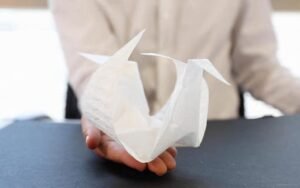
Cross-application of origami into everyday items is something most people don’t notice, and I try to raise awareness of that. In the future, we can expect origami to be used in artificial intelligence, such as through biologically integrating them into androids, artificial limbs, and even nanobots that can navigate itself within our bodies to deliver drugs. We can also expect to see its concept used in shape-warping clothes, where a garment can respond to the environment or through the wearer’s preference. The clothes can automatically hug the body tightly in response to a drop in temperature, or warp to accentuate or minimise certain parts of their figure according to the wearer’s adjustments.
What are some potential career opportunities for someone who is passionate about origami?
Origami is like a platform, similar to maths and is applicable in anything you venture. Origami knowledge can complement industries and technology like architecture, engineering, pattern recognition systems, biochemical protein interactions in drug delivery and many others. Apart from being a full-time origami scientist like myself, origami can help to propel you to an advanced level of understanding and technicality in any profession you choose. It can be thought of as similar to the air-conditioning in a car — without it, the car is still able to function; but with it, you can have a much more comfortable and relaxing drive.
Which countries have implemented origami into their education system?
The first country is Israel, where they have a course called Origametria that has been implemented in kindergartens and primary schools countrywide. It was pioneered by Miri Golan, an origami artist and educator, and has full backing from the Israeli Ministry of Education. In China, Tianjin University has a module on origami structure in its School of Mechanical Engineering. The University of Tokyo and the University of Tsukuba in Japan have also had classes on structural and computational origami.
Harvard University, California Institute of Technology (CalTech), Brigham Young University, and Massachusetts Institute of Technology (MIT) have all introduced origami approaches to complement subjects in mechanical engineering, biological sciences, and pharmaceutical science. Closer to home, Indonesia is currently at the beginning stages in conducting origami classes, an effort which has received full support from their government.
[/ihc-hide-content]