Party-going drug-users turn to Magic Mushroom to revel in psychedelic euphoria
BY JOSEPH MASILAMANY & SHAMIRA SHAMSUDDIN
Kuala Lumpur: Move over meth! Yuppie clubbers are now dancing to sound-enhancing auditory hallucinations that come with a puff of the Magic Mushroom.
Also known by its other street name, “shroom” or “shroomie”, plant compounds from the Psilocybe mushroom – can also cause the user to experience mind-blowing visual alterations such as seeing funnel and spiral geometric images. [ihc-hide-content ihc_mb_type=”show” ihc_mb_who=”2,3″ ihc_mb_template=”1″ ]
According to Harian Metro, a local Malay tabloid the mushrooms are believed to be smuggled into the country from neighbouring Indonesia.
The tabloid in its March 21 publication, said the drug is popular among party-goers in Kuala Lumpur and is popularly used as rolled-up cigarettes.
It is also dried and made into a powder form which is then mixed with beverages including alcoholic drinks and consumed.
The tabloid also reported that the drug is sold between RM80 to RM100 per joint.
Trending now
Though this mushroom has been used by people in the clubbing circuit for quite some time now, it seems to be currently trending as a popular choice currently.
“The active compound in the mushroom, psilocybin, delivers a more potent “kick” than marijuana but has similar effect as ecstasy,” the tabloid reported.
Reportedly, individuals ingesting psilocybin can also become extraordinarily aggressive.
Harian Metro, in its report also stated that psilocybin in the mushroom is classified as a new psychoactive substance (NSP) which cannot be detected via conventional urine tests.
This poses a challenge to Malaysian law enforcement authorities as currently there is no standard screening test for the presence of psilocybin in the system.
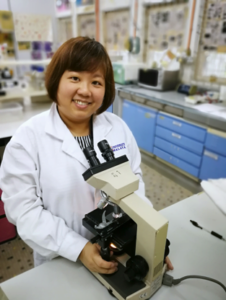
When contacted University of Malaya’s mushroom researcher and Deputy Head of Mushroom Research Centre, Dr Tan Yee Shin (pix), told The Petri Dish that the so-called Magic Mushroom is the common name given to fungi that contain psilocybin – a naturally occurring psychedelic compound.
She said: “Psilocybin converts to psilocin in the body and causes both visual and auditory hallucinations and elicits experiences that are similar to those of dreams.”
Tan said several studies showed that psilocybin is a mood enhancer and causes “affective” disorders.
She said studies have revealed that psilocybin reduced anxiety and depression. It is also known to have diminished these symptoms in terminal cancer patients in recent clinical trials.
However, she said it should be noted that these observations were limited to a study trial.
“It is important that clinical research should be involved with a larger population to investigate and determine the standardised dosage necessary for medical use.
“Although the psychoactive components, psilocybin or psilocin have very low physiological toxicity, studies showed that ingesting it could cause tendencies to self-injure, induce fear, suicidal behaviour, dependency, emotional instability, impaired coordination, and substantial psychiatric problems,” Tan cautions.
She also cautioned that there are websites selling Psilocybe mushrooms. However, information shared by those sellers might not be accurate.
“This could lead to wrong information from misidentification of species and the correct process of preparation and the dosage used,” she added.
Fatality
Worldwide there is only one known case of fatality involving the use of the Magic Mushroom. Last year it was reported that a Singaporean man jumped to his death from the fifth floor of his hotel room in Bali after ingesting the mushroom.
According to media reports 23-year-old Ong Chee Seng had been hallucinating when he flung himself in the early hours of May 6 from his hotel room in Legian, Bali.
A take from Popular Science
However, Popular Science in its May 26 publication last year claims that Magic Mushrooms are the safest drugs to “play around” with.
According to the science publication: “It’s non-addictive, hard to overdose on, and you can grow it yourself. And, according to a massive report by the Global Drug Survey, Magic Mushroom sends the fewest people to the emergency room compared to any other drug on the market.
“Perhaps the most dangerous thing about psychedelic mushrooms is that they’re easily confused for the poisonous kind,” the magazine ordered.
It reported that, there are over 100 varieties of psilocybin-producing mushrooms which makes you trip when you eat them.
“Some of them are bound to look like toxic varietals, especially if you’re in a hurry to get high. Just as you should never go to a grocery shop while hungry, you should never go mushroom-hunting while jonesing for a trip,” it added.
According to Poison Act 1952 (Revised 1989); Poisons (Psychotropic substances) Regulations 1989; Sales of Drug Act 1952 (Revised 1989); Dangerous Drug Act 1952 (Revised 1980), possession, sale, and purchase of Psilocybe mushroom or the psilocybin and psilocin are listed as controlled substances under the current Malaysian law.
Editor’s Note: The Petri Dish has refrained from using images of the Magic Mushroom to prevent identification and misuse of the plant by the public. Disclaimer: The Petri Dish also does not endorse the use of any illegal drug for recreation or self-treatment.
More>> Mycologist: 16 species of Magic Mushrooms found in Sabah
[/ihc-hide-content]