OIL palm breeding programme in Felda Global Ventures Holding Bhd (FGV) was first established in 1969 at Tekam,Pahang (known as Pusat Penyelidikan Pertanian Tun Razak, PPPTR) with a total of 2,130 hectare dedicated for various breeding programmes.
The main objectives were to breed for superior planting materials (oil yield) and at the same time to explore and exploit the germsplasms of various materials.
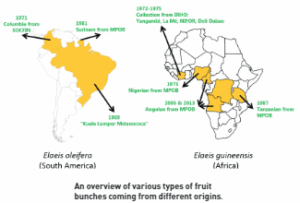
[ihc-hide-content ihc_mb_type=”show” ihc_mb_who=”2,3,5″ ihc_mb_template=”1″ ]Our strong breeding programme is supported with a huge pool of oil palm germplasms materials ranging from Elaeis oleifera from Latin America and Elaeis guineensis from Africa.
Felda Yangambi ML-161
Till present, there are a minimum of five pools of Deli-Dura materials being developed, namely: Elmina, Ulu Remis, Banting, Kulai and CIRAD (previously known as IRHO).
As for Pisifera, the earliest elite pool was derived from La Me and Avros sources before Yangambi was tested extensively.
Among the earliest commercial materials in FGV were mostly La Me and Avros origin.
The La Me material which offers higher number of fruit bunches is not favourable to the Felda planter due to its “spikiness”, making it less optimal for handling in the field.
In comparison, Avros-based materials offer high mesocarp to shell ratio but it is compensated with its vigorous vegetative growth particularly in terms of annual height increment.
In a later field study, it was found that DxP from the Yangambi group showed superiority in terms of oil yield.
The blockbuster Yangambi ML-161 was discovered in 2002, when a specific Yangambi individual species with good combining ability (GCA) and high yields was identified.
Based on the observation, DxP Yangambi ML-161 showed remarkable oil yield improvement of close to 32 per cent with 31 per cent improvement on Fresh Fruit Bunch (FFB) against the SC3
This product is currently the famous FGV Yangambi ML-161 sold in the market by FASSB and more so, FGV had successfully penetrated the Indonesian oil palm seeds market where it was successfully registered.
This is an international recognition and acknowledgement on the works and quality that FGV had invested in. This achievement is not possible without the strong research and development (R&D) support.
FGV 3-way
The potential for Yangambi ML-161 will be exhausted eventually.
FGV has also tapped into the Nigerian prospected material (NPM) made available by MPOB in 1973.
The breeding programme on NPM presented a huge challenge to FGV because materials such as La Me, Avros and Yangambi sources, had undergone some level of trait fixing and improvement prior to the release by MPOB.
As such, introgression of NPM require extensive combinations and crosses, sometimes overlapping between generations, to bring it to the level of Yangambi ML-161 or even better.
In this new NPM programme, the female parent (Dura) was introgressed with NPM (Deli-Banting with NPM) and the pisifera lineage used is maintained withYangambi ML-161 giving rise to FGV 3-way variety.
While the FGV 3-way has a comparable yield performance to FGV Yangambi ML-161, it offers other characteristics that are unique such as higher bunch number, shorter rachis length and lower height increment in comparison with Yangambi ML-161.
These gains in vegetative characteristics allow FGV 3-way to be planted at a higher planting density (148 palms/hectare) which translates into higher overall FFB yield.
FGV GT1
In 2016, FGV had launched another planting material known as “GT1” with high tolerance against basal stem rot (BSR) disease caused by Ganoderma boninense. This is made possible as FGV has identified resistancegene families within the oil palm genome in our effort to combat basal stem rot caused by Ganoderma boninense.
The marker was then further developed and shown to have 70 per cent accuracy when utilised in screening breeding crosses.
To ensure accuracy in identifying tolerant progenies, the selected breeding crosses were subjected to control infection in a high through put Ganoderma nursery trial.
The combination of molecular screening and nursery trial ensures a more efficient and robust selection of the planting materials for commercialisation. This approach of short listing the crosses prior to nursery screening enables FGV to reduce the time and land required to conduct such trials.
The efficiency of selection was increased with use of semi-clonal crosses due to its homogeneity compared to conventional breeding materials.
At present, we are conducting replanting activities with GT1 materials in the fields where BSR incidence was noted to be high and we are confident, as the genetic potential had been proven at the nursery screening level and through the Ganoderma marker selection stage
NOTE: The writer is the Chief Researcher of Oil Palm Breeding Department at FGVR&D, a subsidiary of FGV Holdings Berhad. He is a molecular biologist by training before embarking on oil palm breeding focusing on new planting materials with specific trait of interest for both local and international markets. He has more than ten years’ experience in molecular research works encompassing gene expression study in genomics & transcriptomics work on both oil palm and Ganoderma boninense. Currently, he is in charge of oil palm breeding programme and his research interest is on the development of partial resistant planting materials against basal stem rot caused by G. boninense. For more information, please visit http://www.feldaglobal.com/our-business/plantation/rd-services or drop an email to js.tan@feldaglobal.com
[/ihc-hide-content]