BY JOSEPH MASILAMANY
KINABATANGAN: At long last, the “missing male” counterpart of the orb-weaving spider species Opadometa sarawakensis has finally been found.
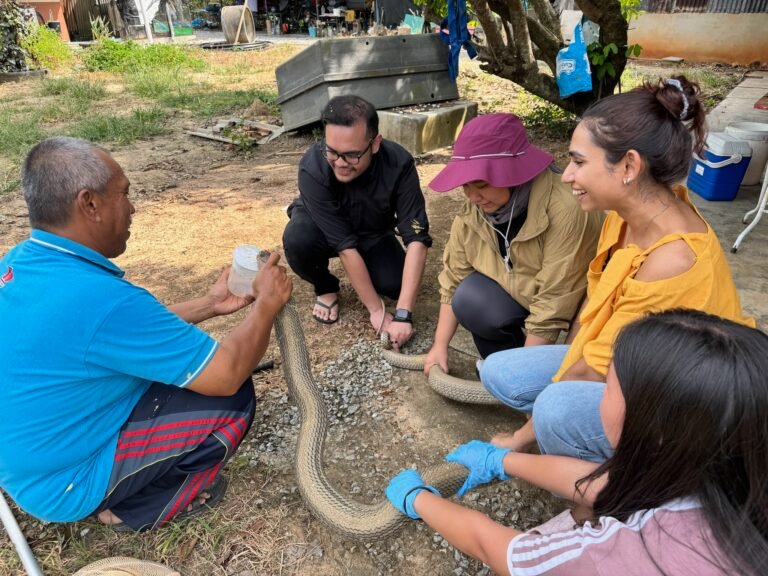
A team of 16 students from Holland on a recent ecology field trip to the Kinabatangan Wildlife Sanctuary here discovered the species known for its flamboyant red and blue colours.
The species was previously identified and known only through its female gender.
The students who were on a two-week study sabbatical organised by Naturalis Biodiversity Centre and Leiden University were hosted by the Danau Girang Field Centre (DGFC) in Sabah. [ihc-hide-content ihc_mb_type=”show” ihc_mb_who=”2,3″ ihc_mb_template=”1″ ]
The team was led by Dutch spider taxonomist Dr Jeremy Miller of Leiden University who told the media that the Opadometa spider genus werefor a long time shrouded in mystery – as the males and females lacked similarity in physical appearance.
“In fact, the males are also so elusive that researchers are still unsure whether the sexes are correctly linked to each other even in the best know Opadometa genus.
When contacted by phone, the director of DGFC, Bennoit Goosens, told The Petri Dish that while the females looked stunning in their blue and red colours and were larger in size, the discovered male specimen was smaller and had a darker shade of orange, grey, black and silver.
Goosens said: “The students found the male counterpart of the species clinging on the web of a red and blue female.
According to Goosens, a wildlife biologist, during the initial discovery of the male spider, the researchers were unable to immediately ascertain the species as the facilities to carry out such an assessment was not available.
“However, using all their expertise and experience from previous field surveys in the area, the team concluded that the male’s observation on that particular female’s web, in addition to the fact that no other Opadometa species were found in the area, was enough to prove they were indeed representatives of Opadometa sarawakensis.
“Adapting to the quite basic conditions of our small laboratory, the students and their mentors put into use various items they had on hand, including smartphones paired up with headlights mounted on goose-neck clips in place of sophisticated cameras,” added Goossens.
“In the end, they gathered all the necessary data to prepare the formal description of the newly identified male. Once they had the observations and the data, there was only one question left to answer.
“How could they proceed with the submission of a manuscript to a scholarly journal, so that their finding is formally announced and recognised?
“Thanks to the elaborated and highly automated work flow available at the peer-reviewed open access Biodiversity Data Journal and its underlying ARPHA Writing Tool, we managed to successfully compile our manuscript, including all underlying data, such as geolocations, and submit it from the field station,” added Goossens who is also a reader at Cardiff.
[/ihc-hide-content]