BY FAISAL ALI ANWARALI KHAN
THERE is a saying in Malay Culture “tak kenal maka tak cinta” which can be translated as “you would not fall in love if you don’t get to know the person”. This is the best phrase that we can describe “bats” that are now in the spotlight with the recent emergence of the COVID-19 virus. There is already widespread cultural misconceptions and myths about bats. Adding any unverified information related to the virus that is raging across many countries will only pose a serious threat to the conservation of this ecologically endangered species.
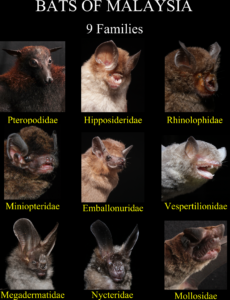
[ihc-hide-content ihc_mb_type=”show” ihc_mb_who=”2,3,5″ ihc_mb_template=”1″ ]Bats from the Order Chiroptera are the second-largest Order after Rodentia which have the most number of mammalian species. There are more than 1411 bat species known worldwide, and of this, at least 136 species are found in Malaysia. Bats are so diverse and consume various types of food. Their food comes from various categories such as: nectarivory (nectar), frugivory (fruit), insectivory (insect), piscivory (fish), carnivory (meat, e.g. small rodents, other bats and frogs), and sanguivory (blood).
One of the long-standing legendary myths is that vampire bats will attack humans and feed on their blood. This is similar to the vampires reflected in movies with long canine teeth which they use to puncture the human body before feeding on blood. Interestingly vampire bats neither use the canine tooth to puncture their prey nor feed on humans. Vampire bats typically use their incisor teeth rather than the canine to create an incision before feeding on their prey’s blood. Further, this bat species (mostly found in the South-Central American region) primarily feed on cattle, not humans.
Bats are nocturnal species and are only active during the night. For this reason, they are thought to be blind. Bats are not blind. However, most bats can’t see well especially those that use the biosonar mechanism to find their way. Bats that use biosonar or echolocation, are in fact able to better perceive the environment than humans in total darkness.
Echolocations are soundwaves made to detect objects around them. Bats use ultrasonic echoes which are above human hearing >20 KHz. This unique ability of bats to use echolocation enables them to see in the dark. They are great hunters and are able to go places where many other species stay put during the night.
Many of us are also unaware of some of the ecological importance and the key role bats play in the ecosystem. Bats ensure the survival of fruit trees and forest plants as they serve as pollinators of flowers and seed dispersers which are important for forest regeneration. Many of us in Southeast Asia especially Malaysia love durians (Durio zibethinus). However, not many of us know that bats are the main pollinators of the durian tree. Studies have shown that, without them, we may not have our delicious durian. Banana (Musa spp.), and petai (Parkia spp) are other good examples of fruiting trees that depend on bats for pollination. Without them, these trees will have difficulty in propagating. These bats also promote the agricultural industry by pollinating economically important crops.
Another important ecological service that bats contribute is consuming insects as part of their diet. Studies have shown that bats can consume one-half of their body weight every night. These insects can be agricultural pests, pathogen carrying mosquitoes and many others that can cause illnesses. Having bats removed from the ecosystem would lead to problems socially and economically to humans.
Despite their key role in the ecosystem, bats are now seen as a threat to humanity as they are seen as a reservoir hosting various disease-causing agents. Studies have shown that bats can harbour a variety of microorganisms including viruses to which they are immune to. However, there is no clear evidence that bats transmit disease to humans. Studies also suggest that humans may get infected either through direct consumption of bats and other wildlife. It is therefore critical for us to avoid any sort of bushmeat consumption. Historically bats have been always associated with rabid animals and thought to attack humans. It is important to note that most bats do not carry the rabies virus. Bats that carry this virus are different from others in terms of their behaviour and are typically non-aggressive. Bats with rabies can be seen active during the day, roosting away from others and are weak.
As we start to know more about bats, we will realise that there are a lot of fascinating characteristics of bats from how bats manage to hang upside down most of the day to their ability to fly long distances and harbour many pathogens.
Let us stop worrying about them. Keep calm and love bats.
NOTE: Faisal Ali Anwarali Khan is a researcher and lecturer at Animal Resource Science and Management Programme Universiti Malaysia Sarawak (UNIMAS). His research is on the systematics and molecular evolution of Southeast Asian mammals, particularly bats. He obtained his PhD and Masters in Zoology from Texas Tech University.
[/ihc-hide-content]