BLOOPERS | Health Minister Dr Adham Baba was recently the laughing stock of the nation for having suggested during a TV 1 interview that drinking warm water could prevent the Covid-19 infection.
This blooper was trending for a while – doing the rounds in social media, jumping from one cell phone to another, is being tweeted and is also giggling aloud in facebook.
[ihc-hide-content ihc_mb_type=”show” ihc_mb_who=”2,3,5″ ihc_mb_template=”1″ ]Perhaps, Adham cringed in a corner in utter embarrassment with “oops, it’s my bad!” twittering on his lips. Take heart Adham. You are not alone in this.
There were others before him who had uttered the “funnies, sillies and non-sensicals and have survived public ridicule all because they did not have a grasp of basic science.
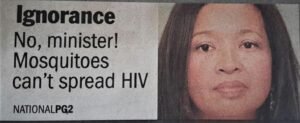
I recall, in 2003 as a reporter covering the “Beyond Faces, Beyond Images Workshop and Media Training Programme” an initiative to highlight HIV/AIDs awareness among the media – the then Malaysian Aids Foundation chairperson Datin Paduka Marina Mahathir in her keynote address saying, that misconceptions about the disease is so widespread among the general public, that even a minister had asked her, “if Aids could be transmitted by mosquitoes”.
Marina was polite not to mention the minister’s name, but went on to say this is reason why educating the public about the disease must be on-going.
My story got a second page lead position and earned a front page blurb teasing, “No, minister! Mosquitoes don’t transmit HIV”
The A(H1N1) pandemic
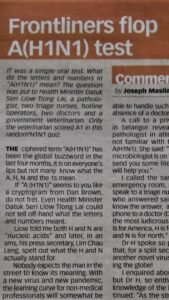 In 2009, at the height of the A (H1N1) pandemic, I was assigned to pose a simple test to frontliners involved in managing the outbreak. The test was to gauge how knowledgeable and capable the frontliners were as the pandemic reached global concerns.
So I went undercover and made several calls. The first call was to then health minister Liow Tiong Lai. My question was simple: “What do the letters and numerals in A, H, 1, N, 1 mean?
I told Liow, that I was a member of the public and was curios to know what “A(H1N1)” means. Off hand, he did not have the answer but later his press secretary, Lim Chau Leng, informed me via sms that H and N refer to nucleic acids present in the virus.
Of course, the minister, being a layman, I do not expect him to know the nitty-gritty details of hardcore microbiology, but still, some reading up being a minister would have been in good order.
My next call went to frontliners monitoring the government hotline. A lady answered, saying A(H1N1) was a flu. I told her it is a bug that causes a certain kind of flu which can kill, but why is it called A, H, 1, N, 1?
She asked me to hold the line while she checked with another officer and I heard a male voice retorting in the background: “Mana aku tau?” (How do I know?). Then he came on line saying: ‘Actually ah, Sir, they are just letters to differentiate the strains of the many kinds of flu viruses.
But I persisted to ask what the A, H, N and the two numerals mean, and he replied, “they have no significant meaning, Sir.” I asked him, if a doctor was available who could answer my question, he replied in the negative. I thought it was little odd that the hotline for the National Influenza Pandemic Preparedness Plan was operating without a medical personnel on the deck.
My next target was a private hospital in Petaling Jaya. I called the lab and asked to speak to the pathologist. I asked her the same question and she replied: “Oh dear, my microbiologist is on leave, but I can send you some literature on it.” I hung up.
I can certainly excuse Liow if he did not have a ready answer to that question, but a pathologist!
This one takes the cake!
I called the same hospital’s emergency room, asking to speak to the triage nurse. She came on line, I put my question and she instantly said: “I don’t know,” but said she will pass the phone to a doctor.
Dr H came on line and I put my question. I was shocked by what he said, though it was ludicrous as it was.
Dr H: A is for America, H is for hemisphere and N is for north.
Dr H spoke so professionally, that I thought another new novel virus was circulating the globe.
I inquired about the two numerals 1, and another 1, but Dr H was so enthused with his knowledge of the influenza, he continued speaking excitedly: “As the strain originated from America and since America is in the northern hemisphere, it was named A (H1N1),’ he concluded.
I almost died. If the doctor does not understand the letters and digits of A(H1N1), or of the seasonal flu A(H3N2), how has he been treating cases of the common flu all this time.
Veterinarian gives right answer
It was to be my last call and I targeted a government veterinarian in Petaling Jaya. What a big surprise, the animal doctor scored top marks in this random quize!
I put the same question to Dr K.
Dr K replies: All influenza strains are classified as A, B, or C. In A(H1N1), “A” refers to the influenza category. The “H” is haemaglutinin, a surface protein that binds the virus to the host cell which is being attacked. “N” stands for neuraminidase, an enzyme that penetrates the host cell. Both, “H” and “N” are present in the cell membranes of the viruses. There are 16 kinds of “H” and only nine kinds of “N”, and that is why we have the numerical digits in influenza strains.
Dr K further explained: “The bracketed letters and numerals refer to the specific strain or sub-type of the category.”
Congratulations Dr K you made my day as a journalist! pd
[/ihc-hide-content]