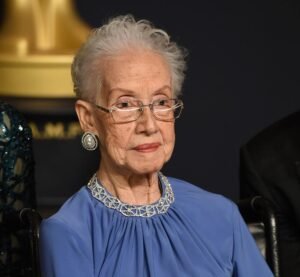
A BRILLIANT mathematician at the National Aeronautics and Space Administration (NASA) and a trailblazer for women in science, Katherine Johnson broke racial and gender barriers as one of the first few African-American women to work as a NASA scientist. During her time at NASA from the 1950s to 1980s, she became renowned for her mathematical prowess, and was responsible for putting the first Americans in space, calculating the trajectories for their space flights and subsequent crewed space missions. Becoming an avid spokesperson for STEM education in her later life, her work has inspired generations of people to follow in her footsteps, showing that anyone can triumph in their desired fields, no matter the obstacles placed before them.[ihc-hide-content ihc_mb_type=”show” ihc_mb_who=”2,3,5″ ihc_mb_template=”1″ ]
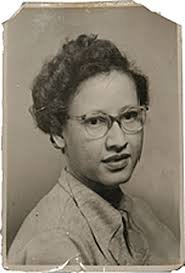 Creola Katherine Coleman was born in White Sulphur Springs, West Virginia. As a child, she had an affinity towards mathematics, and accelerated through her education, enrolling into high school at age 10. She graduated with highest honours from college at 18 with degrees in mathematics and French.
In 1953, she joined the National Advisory Committee for Aeronautics (NACA) as part of the West Computers — African-American women who perform and analyse complex calculations for engineers. While at NACA, she stood out for asking questions, something most of the other women didn’t do. “I asked questions; I wanted to know why. They got used to me asking questions and being the only woman there,” she said. She also faced the pressures of racial segregation during her time at NACA, as she still had to use separate bathrooms and dining facilities until the centre transformed into NASA in 1958.

In 1962, she mapped out and calculated the trajectory of the space flight for Alan Shepard, the first American in space. She was also known for calculating and verifying the trajectory of John Glenn’s orbit around Earth. In spite of the expensive and newly-installed IBM computers NASA had brought in to perform the complex orbital calculations needed, Glenn famously refused to fly and insisted to “get the girl,” referring to Johnson. “If she says they’re good, then I’m ready to go.” Glenn’s mission was a success, and Katherine Johnson cemented her place in NASA as one of the most formidable aerospace technologists of her time.
After 33 years of service, Johnson retired and became a champion for STEM education. She often encouraged students to pursue careers in STEM, stating that “we will always have STEM with us. Some things will drop out of the public eye and will go away, but there will always be science, engineering and technology. And there will always, always be mathematics.”
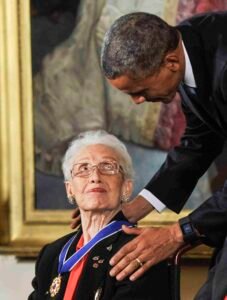
In 2015, she was honoured with the Presidential Medal of Freedom, the highest civilian award in the United States. It was bestowed upon her by former President Barack Obama, who lauded her as a “pioneer who broke the barriers of race and gender, showing generations of young people that everyone can excel in maths and science and reach for the stars.”
A year later, NASA dedicated a new building to her at the very same centre that she had worked during her tenure as a mathematician. The building was named the “Katherine G. Johnson Computational Research Facility”. Later that same year, a movie chronicling her time at NASA, along with two other African-American mathematicians — Dorothy Vaughan and Mary Jackson — was released to critical acclaim. Her journey and work were now immortalised and illuminated to a new generation of people.
Johnson passed away at the age of 101, at a retirement home in Newport News, Virginia on February 24, 2020. NASA administrator, Jim Bridenstine, honoured her memory with a statement, describing her as “an American hero”, and that and “her pioneering legacy will never be forgotten.”[/ihc-hide-content]