MUSLIMS perform five mandatory prayers a day – fajr (subh), zhuhr, asr, maghrib and isha’a.
Each one of these prayers must be performed within a set time. Islamic astronomy or falak syarie plays a significant role in determining the accurate time for the performance of these prayers.
Apart from facing the qiblah (praying facing the direction of the Kaaba), the timing is also important for Muslims to perform prayers. This is an area where Islamic astronomers or falak scientists are involved and they work hand in hand with the ulamas (Muslim scholars). [ihc-hide-content ihc_mb_type=”show” ihc_mb_who=”2,3,5″ ihc_mb_template=”1″ ]
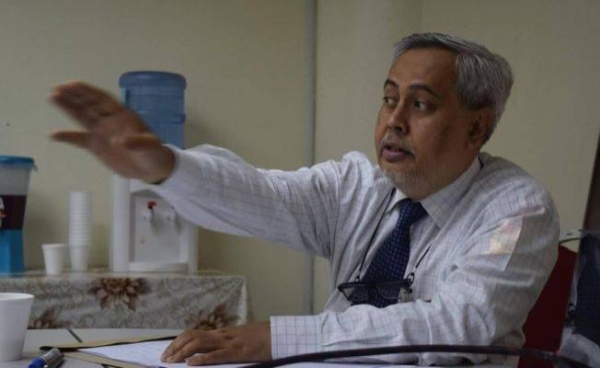
“To know the timings of zuhr, asr and maghrib prayers has never been a problem because they have already been verified clearly by nas ( an explicit statement within the Quran or hadith) and the measuring parameters used are more easily determined because the movement of the sun could be measured by the length of the shadows that are visible,” says Dr Raihana Abdul Wahab, Senior Lecturer for Islamic Astronomy Program from the Department of Fiqh and Usul, Academy of Islamic Studies, University of Malaya.
However, she told The Petri Dish in an interview recently, “it is not easy to know the timing of the fajr prayer because the sun is positioned below the horizon and thus, the measurement of its shadow cannot be performed,” she added.
According to her, the difficulty arises in determining the starting moment for fajr prayers. “How do you define “subh” or “fajr”? How do you explain the difference between the “false” dawn and the “true” dawn?” she explained.

Raihana said from the scientific point of view, the light which appears before sunrise and remains after sunset is known as “twilight”. Twilight means “the light between the two”- between night and day or between day and night.
Twilight occurs when Earth’s upper atmosphere scatters and reflects sunlight which illuminates the lower atmosphere.
It is obvious that the light of morning twilight gradually increases in brightness to distinguish the various stages of twilight, the scientists have divided it into three types of twilights:
1. The Astronomical Twilight: this begins when the Sun’s centre is 18 degrees below the horizon.
2. The Nautical Twilight: this occurs when the Sun’s centre is at 12 degrees below the horizon.
3. The Civil Twilight: this occurs when the Sun’s centre is at 6 degrees below the horizon.
Raihana said that her research project which was funded by the Department of Islamic Development Malaysia or Jabatan Kemajuan Islam (Jakim) aimed to standardise the fajr prayer time for the Kelantan state with other states in Malaysia. A parameter of 19 degrees the Sun’s below the horizon is used in Kelantan whereas 20 degrees the Sun’s below the horizon is used in other states in the country to determine the beginning time for the fajr prayer. Although it differs by only one degree, this one degree is equivalent to four minutes thus resulting in a big time difference.
This becomes more crucial as the accurate fajr prayer time involves two important rituals in the lives of Muslims; the prayer and fasting obligations.
“Kelantan uses 19 degrees the Sun’s below the horizon instead of 20 because it has been practised following the ijtihad (independent reasoning) by the previous Mufti of Kelantan, Tuan Guru Haji Muhammad Nor Ibrahim. While other states follow the ijtihad from Sheikh Tahir Jalaluddin.
Thus my research team needs to propose solutions to the Jakim to standardise the parameter in calculating the beginning time of fajr for the entire nation.
And this project came up with a systematic and scientific method in measuring and imaging the sky brightness. The research project also aimed to find and propose the Sun depression angle that is consistent with the starting time for Fajr prayer,” said Raihana
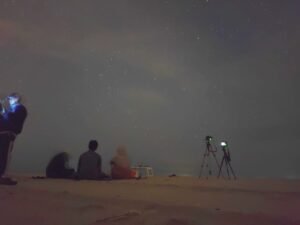
To observe the twilight spectrum, her research team travelled around the country and their job requires them to stay in remote areas far from the light pollution. They start their research as early as 4am. For a field like Raihana’s it is very difficult to get research assistants because they are not willing to work long hours in remote areas under these circumstances.
The selected location must be a clear eastern horizon where the sunrise could be seen with the naked eyes and preserve from light pollution. They also observed that the light changes through the sky quality meter, a device developed by the research team, and a digital single-lens reflex (DSLR) camera to obtain reliable data.
“Before we do data collection at the observatory location, we have to refer to the hijri or Islamic Calendar to know the moon phases. We want to avoid the moon rise or full moon which will affect the data collection as it is considered as natural light pollution. Usually, we will do research between the first and twelfth day of the month according to the hijri calendar because that is the time when the moon sets,” she explained.
“Once you have seen the sky through the telescope, you will fall in love with its beauty,” said Raihana excitedly.
 Based on the research outcome, her team proposed to Jakim that fajr occurs at 18 degrees the Sun’s below the horizon (in line and consistent with the astronomical twilight) instead of 20 degrees. Jakim agreed with their proposal and last year on Nov 29, Jakim Selangor (Jais) was the first to announce and implement an additional eight minutes to the fajr prayer time throughout Selangor.
Now, all states in Malaysia are using the same parameter which is – fajr occurs when the Sun’s centre is at 18 degrees below the horizon and the prayer time is now 8 minutes later than the previous.
Personally, Raihana went through a tough time throughout the research period. Three of her close family members passed away within a month while she was busy with her research. Although she was emotionally affected, she looked for motivation from within to continue and complete her research work because for her, the research is very important for the ummah (congregation), she said.
“My strong support system is my husband as he always encourages me to continue my research whenever I felt demotivated,” said the mother of two children.
As a woman in a male dominated field, she made sure that she is capable of leading the research group by equipping herself with sufficient skills and knowledge. She constantly reads to keep herself well informed in order to be a competent woman Islamic astronomer or falak scientist.

Raihana also said, with her knowledge gained through widespread reading she is capable of answering questions and explaining to others which in return has enhanced her self-confidence.
Asked why she chose this research field, Raihana said she wants to be a researcher who could contribute to Muslim society.
“Islamic astronomy is a very important field for Muslims as it helps us to identify the prayer and fasting times based on the movement of the sun and stars, measure qiblah direction for prayers and announce when Muslims can celebrate Eid through the movements of the moon.”
“I am also inspired by other Islamic astronomers from the medieval Islamic world. Islamic scholars such as al-Khawarizmi, al-Fazari, al-Biruni and other Islamic scholars have contributed a lot to Islamic astronomy in which their knowledge and inventions of astronomical instruments were used for Muslim worship. I am happy that my research has given a positive impact on society and helps Muslims to perform their prayers according to the prescribed times,” she said.
Raihana recently spoke at the pre-Women and Girls in Science Forum 2020 recently to encourage women to take up courses with Shariah major in Islamic Astronomy (falak). Many think that studying falak does not have employment prospects.
“Graduates need to think out of the box. They can create their career path. How about being a consultant to property developers to build shariah compliance residential areas facing Mecca, or create a career in astro-tourism. Through the construction of hotels at observatories, staying visitors are offered astronomic observation session packages in order to give exposure of the science of astronomy to the public,” she advised undergraduates who attended the forum. [/ihc-hide-content]