BY MAHALETCHUMY ARUJANAN
SERENDIPITY in research is every scientist’s dream. For Dr Ravigadevi Sambanthamurthi and her co-researchers, it is not just serendipitous research but spontaneous thinking and capturing what missed the attention of many.
Ravigadevi and team at the Malaysian Palm Oil Board were the first scientists in the world to make a major discovery of [ihc-hide-content ihc_mb_type=”show” ihc_mb_who=”2,3,5″ ihc_mb_template=”1″ ] the presence of oil palm phenolics (OPP) in the aqueous stream of palm oil milling.
These phenolics are now becoming a blockbuster health supplement, with 28 patents filed, several of which have been granted, and multiple published articles in top tier journals. When most scientists were focusing on the oil and oil soluble compounds like tocotrienols, tocopherols and carotenoids, Ravigadevi’s mind shifted to the aqueous portion of what is left behind after the oil is extracted.
Her mind started seeing the oil palm bunch that she was familiar with for the past 20 years through an artistic lens. “This is a fruit, just like berries or simply any other fruit and it is so colourful. Colourful fruits are usually rich in watersoluble polyphenols. Why are we not looking at the water-soluble compounds?” The moment she saw the fruit and its compounds from a different angle, her research priority changed. She shared her curiosity with her colleagues Dr Tan Yew Ai and Dr Kalyana Sundram during a tea break.
All that was required to transform her hypothesis to methodology and breakthrough research was the combined minds of a chemist, nutritionist and biochemist. Sundram, Yew Ai and Ravigadevi sprang into action, by establishing protocols to extract phenolic compounds from the aqueous stream, after the oil is extracted.
A breakthrough solvent-free recovery process was established to extract polyphenols, phenolics acids, water -soluble vitamins and organic acids, which was later patented. The compounds were identified using a combination of High-Performance Liquid Chromatography (HPLC), LCMS and NMR and screened for antioxidant and free-radical scavenging activities to assess the potential health properties of the phenolic extract.
The hidden gold mine
The palm oil milling process generates an estimated 45 million tonnes of aqueous stream annually which are largely discarded. In reality, we have been throwing away some of the most valuable compounds in our golden crop. The phenolics when extracted are much more expensive than palm oil itself. These are strong antioxidants, with multiple health benefits.
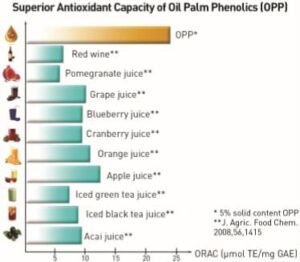
The jewel in the crown among the phenolics is resveratrol, usually extracted from grapes, blueberries, raspberries, mulberries and peanuts. However, this was before OPP was discovered. The antioxidant capacity of OPP surpasses those of most fruits tested. OPP is a potent bioactive compound that offers myriad health benefits ranging from antimicrobial, anti-inflammatory, anti-cancer, anti-diabetic, anti-hypertensive, anti-atherogenic, anti-obesity, antispasmodic, anti-thrombotic, antiallergenic, anti-ulcer and enhances cognitive functions.
“No, it is not a snake oil”, counters Yew Ai, to the comment that the list of OPP wellness benefits reads like a snake oil commercial. “We did extensive research to verify its capabilities and clinical studies are on-going. All its benefits stem mainly from its anti-inflammatory properties.
As we know, most diseases are caused and exacerbated by chronic low-grade inflammation. In vivo, cell culture, animal studies and microarray procedures have confirmed these properties.” The team in collaboration with Brandeis University used the Nile Grass Rat ( Arvicanthis niloticus ) to study diabetes.
This specimen is a good model as it naturally feeds on grass on the Nile banks and is used to an active life. When brought to the lab however, and given ample food with limited exercise, it develops all the symptoms of metabolic syndrome and Type 2 diabetes. This provides an excellent analogy to our own sedentary life. The results were extremely promising, with OPP mitigating the onset and progression of diabetes.
Other studies were conducted including on neuroprotection and improvement in cognitive function to ascertain other beneficial properties of the compound, using animal models.
Made in Malaysia
This research offers a paradigm shift in palm oil usage. The MPOB team could add several feathers to its cap as it discovered a hidden gem in what was thought to be an environmental bioburden, thus turning a problem into an opportunity.
The discovery also offers the most needed solution to health problems plaguing global population. In short, potential environmental, economic and health impact – all in one breakthrough research. Asked what supported her research, Ravigadevi was quick to respond, saying, “MPOB top management, teamwork, sustainable funding, targeted priority, a conducive research ecosystem and freedom to explore basic research which is a luxury for private companies”.
MPOB Director General Dr Ahmad Parveez and his predecessors were quick to realise the tremendous value of sustained research on oil palm phenolics. “This is truly a ground-breaking discovery and has a whole spectrum of bioactivities that will allow it to penetrate the functional food and nutraceutical markets” iterates Parveez who was instrumental in the commercial success of OPP.

The MPOB team began its research in the late 90s and filed the first patent for the extraction process in 1998, way before olive reached its fame for its phenolics, but due to the demonisation of oil palm and the palm oil trade war, the team was cautious and carried out extensive research to ascertain the safety and efficacy of the extract.
While it is a “made in Malaysia research”, MPOB firmly believes that science cannot thrive in isolation and forged strategic alliances with national and international centres of excellence which further added to the success of this research.
These included MIT, Harvard, Brandeis University and Wayne State University in the USA; and CSIRO in Australia; and University of Malaya (UM) and Universiti Kebangsaan Malaysia among others. Dr Leow Soon Sen who carried out ground-breaking research OPP on on the effect of gene expression went on to receive his PhD from UM and is currently a senior officer with MPOB. He continues to break new ground in this exciting area of research. Another MPOB officer, Dr Syed Fairus led the first-ever Phase 1 Clinical trial on OPP to establish its safety for human consumption.
The road to commercialisation
The phenolics technology was licenced to Phenolaeis Sdn Bhd which has strong links to the Massachusetts Institute of Technology (MIT), a collaboration partner of MPOB. Professors Chokyun Rha and Anthony J. Sinskey, wellknown figures in Malaysia for the Malaysia-MIT Biotech Partnership Programme were adamant that the Malaysian technology be commercialised by a Malaysian company.
The search then started to find investors and industry partners but was to no avail. While almost all appreciated the scientific strength of the technology, they were hesitant to enter an untested market. “This was our dilemma, We were ahead of the game and it became obvious that what drives science does not necessarily drive business,” says Sundram.
“This is a technology that can power the sustainability of the oil palm sector and revolutionise the industry. It has all the ingredients for sustainability – social, economic and environmental dimensions but there were no local takers,” chips in Yew Ai.
After a long search that lasted five years, Sinskey met up with an MIT alumnus from Mexico who specifically donated funding for work on oil palm. Phenolaeis then entered into a partnership with two Mexican firms, AlEn and ECOM Trading and constructed the world’s first commercial OPP production plant, based on a home-grown Malaysian technology, in Palenque, Chiapas, Mexico.
“The substantial foreign capital investment attests to confidence in the Malaysian intellectual capital and innovation capability, and exemplifies a model for commercialisation of Malaysian technologies into global businesses,” says Parveez.
Parveez also stressed that MPOB has more than 600 ready-tomarket upstream and downstream technologies. He says MPOB welcomes investors and SMEs to commercialise these made-in Malaysia technologies for public good.
Phenolaeis, is now leveraging the cutting edge research and turning OPP into a health specialty ingredient trademarked as Palm Fruit Bioactive Complex (PFBc). Phenolaeis CEO, Dr Kevin Ohashi says the product is very well received by USA consumers since its release in Sept 2019.
Currently manufactured in Mexico, Ohashi intends to start an operation in Malaysia to serve the Asian market.
Beyond orangutan
Ravigadevi says it is time to position oil palm and palm oil in the good books of the global population. She believes PFBc will be able to do that. PFBc has applications in a wide range of industries such as functional food, nutraceuticals, pharmaceuticals, cosmeceuticals, and pet food industry.
“One per cent of the functional food and beverage industry in the USA amounts to about USD1.3 billion”, says Ravigadevi. “There is huge potential with this product if we are able to position it right,” she says in optimistic excitement. [/ihc-hide-content]