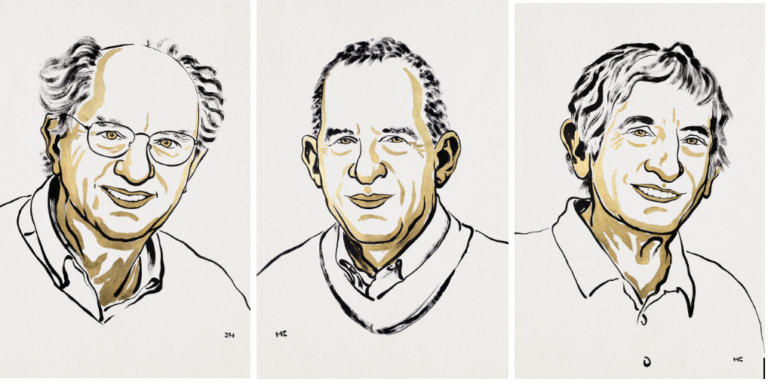
The 2025 Nobel Prize in Physics has been awarded to John Clarke, Michel H. Devoret and John M. Martinis (From L to R) for their pioneering experiments that revealed quantum mechanical effects in a device large enough to be held in the hand — a leap that brings the strange world of quantum physics into tangible reality.
The trio’s groundbreaking work in the 1980s used superconducting electronic circuits to demonstrate two key features of quantum mechanics — tunnelling and quantised energy levels — in a macroscopic system. Their achievement has opened new pathways toward advanced quantum technologies, including quantum computers and sensors.
[ihc-hide-content ihc_mb_type=”block” ihc_mb_who=”unreg” ihc_mb_template=”3″ ]Making the Invisible Visible
Quantum mechanics, the theory that governs the behaviour of the smallest particles in the universe, predicts phenomena that defy everyday intuition. One such process, known as quantum tunnelling, allows particles to pass through barriers that would be insurmountable under classical physics.
Normally, these effects disappear when large numbers of particles are involved. But the Nobel laureates’ experiments showed that quantum principles can be observed in systems made up of billions of particles acting together — effectively making quantum physics visible at a scale we can hold.
A Handheld Quantum World
In 1984 and 1985, Clarke, Devoret and Martinis built an electronic circuit using superconductors, materials that conduct electricity with zero resistance. The superconducting parts were separated by an ultra-thin, non-conductive layer, forming a Josephson junction —a structure long known to display quantum behaviour.
By meticulously refining the properties of this circuit, the team was able to make the system act as if it were a single macroscopic quantum particle. Initially, the current flowed through the circuit without any voltage — a trapped state akin to being stuck behind an invisible energy wall.
The breakthrough came when the researchers detected the system’s escape from this “zero-voltage” state — a sign that it had tunnelled through the barrier, a distinctly quantum event. The escape was measured as the sudden appearance of a voltage, confirming the phenomenon predicted by theory.
Further measurements revealed that the system’s energy was quantised — meaning it could only absorb or emit fixed amounts of energy, another hallmark of quantum mechanics.
Bridging Theory and Technology
“It is wonderful to be able to celebrate the way that century-old quantum mechanics continually offers new surprises,” said Olle Eriksson, Chair of the Nobel Committee for Physics. “It is also enormously useful, as quantum mechanics is the foundation of all digital technology.”
Quantum principles already underpin modern life — from the transistors in smartphones to the lasers in optical communication. However, the laureates’ experiments have helped lay the groundwork for the next generation of quantum technologies, including unbreakable quantum cryptography, ultra-sensitive quantum sensors, and the long-sought quantum computer.
Their success proves that quantum mechanics is not just the science of the invisible — it is also the science of the future, one that continues to reshape how humanity understands and engineers the world around it.
[/ihc-hide-content]