Researchers from Universiti Putra Malaysia (UPM) have successfully produced ‘Photosynthesis Enhancer’ using carbon dots technology. The gadget is capable of increasing crop yields between 20 and 30 percent.
Through the innovation, the photosynthesis rate increases between 20 and 80 percent depending on the type of crop. Furthermore, the cost to produce carbon dots is about 90 percent lower than the conventional method.
The increase in photosynthesis rate encourages plant growth, shortens the harvest period, and increases yields.
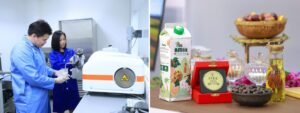
The head of the research group, Assoc Prof Dr Suraya Abdul Rashid, said the product, HARVAST, uses carbon dots with a particle size of less than 10 nanometers (nm).
“When HARVAST, in its liquid form, is sprayed onto leaves, its very small particle size allows it to be absorbed into the leaves till the chloroplasts.

“Carbon dots help to transfer electrons during the photosynthesis process, which can directly increase the rate of photosynthesis rapidly,” explained.
Suraya, who is also the Head of the Laboratory of Material Processing and Technology, Institute of Advanced Technology (ITMA), UPM, said that carbon dots belong to a group of nanomaterials with carbon as its basic material.
According to her, the technology is focused on accelerating the photosynthesis rate which can yield a better harvest compared to other plant growth enhancers available in the market which focus more on plant nutrient requirements and root growth.
She said that accelerating the photosynthesis rate also reduces the use of light and water consumption during the photosynthesis process.
“This is a form of agricultural technology of the future which allows indoor and vertical farming as the photosynthesis process can occur in a dim environment as in a house which uses ordinary light,” she said.
She also said that HARVAST can be used for all types of plants except C4 categorized trees such as maize and sugar cane as their photosynthesis process is different from C3 trees such as vegetables and fruits including durian.
She said HARVAST only needs to be sprayed on plant leaves once a week or fortnightly depending on the tree type.
“Because it is made of carbon, an organic matter, and its production method which does not include the use of any harmful chemicals, the crop yields are safe to eat,” she said.
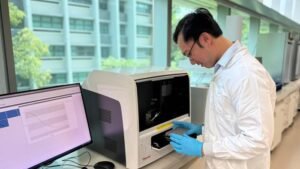
According to her, carbon dots are produced using bio-char (bio-charcoal) which is crushed and put into water before being exposed to temperatures between 200 and 300 degrees Celsius. Carbon dots will glow when exposed to Ultraviolet (UV) light.
She disclosed the study on photosynthesis enhancers started in 2015 and has been tested on vegetables, chilies, and paddy at the Faculty of Agriculture, UPM. The technology was patented in 2016, and efforts to scale it up are now being carried out through the InnoHub programme, at Putra Science Park UPM.
“Through HARVAST, the photosynthesis enhancer, crop yields are improved, water use is more efficient, use of light during photosynthesis is reduced and more carbon dioxide is absorbed by plants, and it is a green technology,” she said.
In addition, carbon dots can also be used in the energy sector such as solar cells and supercapacitors as well as various sensor systems. Its special electrical and optical properties help in the transfer of electrons which indirectly makes the process more effective.