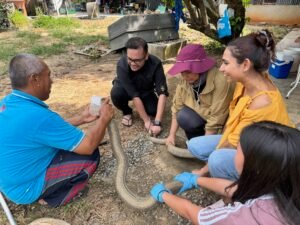
Watching Dr Puspa Ramloo, who hails from Segamat, Johor at work in her House of Pluto veterinary clinic in Lagos, seems like a scene out of Daktari – an American made-for-TV, 60s serial starring main actor – Marshall Thompson as veterinarian Dr Marsh Tracy, and Cheryl Miller as Paula Tracy who played the good doc’s animal-loving daughter.
“Daktari” is the Swahili term for doctor and here in Nigeria’s Ikoyi – an upscale residential area in Lagos, our own Daktari in Dr Puspa Ramloo holds court, driven by a deep concern for zoonotic diseases, animal welfare, and conservation of their habitats.
Recently, Puspa spoke to The Petri Dish about the latest virus playing out its hostility in the African continent and pushing its death-dealing viral load to other parts of the globe.
“Monkeypox, Puspa explains without batting an eyelid is a viral disease caused by an enveloped double-stranded DNA virus of the Orthopoxvirus genus. While the virus mutates slowly, making it somewhat easier to monitor, it can still spread through direct contact with infected skin, bodily fluids, or contaminated surfaces, as well as contact with infected animals.”
Puspa is quick to note that although the illness is typically mild, it can pose severe risks to children, pregnant women, and those with compromised immune systems. Symptoms like blistering rashes, fever, and swollen lymph nodes are common, but cases in Africa have shown varying levels of severity depending on the viral “clade,” or subgroup.

“Clades represent different genetic groupings of the virus and have varying degrees of severity. Clade 1 is more virulent, with Clade 1b—known as the Congo Basin clade—posing particularly high risks to young children. This clade, which has primarily caused outbreaks in Central Africa, can result in more severe symptoms and has a higher rate of human-to-human transmission. Meanwhile, Nigeria has mostly encountered Clade 2, a less severe form of the virus,” she explained.
Reflecting on the broader trends in zoonotic diseases, Puspa highlights the rise of these diseases as a consequence of human-driven environmental changes.
“Human encroachment into wildlife habitats, deforestation, and climate change have all intensified the interaction between humans and wild animals,” says the passionate veterinarian.
These interactions increase the chances of disease spillover, underscoring the urgent need to protect ecosystem balance as a strategy for disease prevention.
Evolving role of veterinarians
Puspa feels there must be a growing role of veterinarians in public health with the emergence of zoonotic diseases from time to time. As zoonotic diseases increase, she believes that veterinary programmes must evolve to equip future veterinarians with skills in epidemiology, pathogen characteristics, and disease prevention.
“Understanding the roots of disease transmission and educating the public are among the essential duties of veterinarians today. She points out that effective collaboration between veterinarians and medical doctors is also crucial, suggesting that joint efforts in research, symposiums, and governmental support can strengthen global efforts against zoonotic diseases,” she suggested.
Returning to her Malaysian roots, Puspa reflects on the state of veterinary education in her home country. Though progressive in veterinary education, Malaysia offers limited study opportunities with only two universities providing veterinary programmes.
Despite this, Puspa notes that Malaysia has effectively managed zoonotic diseases, such as rabies. However, she believes that further expanding veterinary education and enhancing ethical standards within the profession could better prepare Malaysia for future public health challenges.
When asked for advice for young Malaysians interested in veterinary medicine, Puspa encourages them to pursue careers driven by passion.
“Only if you love what you do can you bring about the best outcomes—for yourself and for the nation.”
Her journey from Malaysia to Nigeria stands as an inspiring testament to the impact a committed veterinarian can have, not only on animal welfare but also on public health and the fight against zoonotic diseases.