BY AHMAD ASHMAN BIN AHMAD FAIRUZ
BRIDGING the gap between social science and natural science is a huge task in Malaysia since there is very minimal collaboration between scientists from these two fields. The current pandemic being the greatest teacher has given a wakeup call on the importance of social science working hand-in-hand with natural science to manage a crisis better.
“The past one-and-a-half years show that sound Science, Technology and Innovation (STI) policies are sorely needed, not only in Malaysia but around the world. The way Covid-19 was handled – or mishandled – says it all”, said Dato’ Peter Ng, UCSI University Vice-Chancellor and Founder during the launch of the Tan Sri Omar Abdul Rahman Centre for STI Policy Studies.
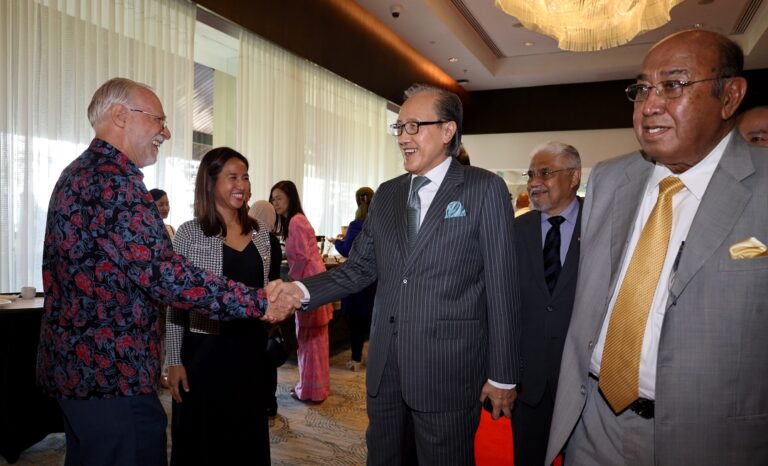
The centre was launched by Professor Emeritus Tan Sri Dr Omar Abdul Rahman recently.
[ihc-hide-content ihc_mb_type=”block” ihc_mb_who=”unreg” ihc_mb_template=”3″ ]Omar said the centre will strive to strengthen the national agenda of science, technology and social innovation by raising awareness, facilitating comprehension, encouraging commitment advocating appropriate action and mandating evaluation. Essentially, this centre plays a role in promoting the agendas related to STI, a planner in planning STI policies and also tasked to advocate the establishment of the National STI Action Council.
“The big challenge is implementation. Translating intention into action and successful completion requires an optimal capacity, involving a whole host of dedicated players and competent enablers,” he said.
“So it was a wish come true for me when UCSI University decided to establish a centre for STI policy studies. It is a great honour and I thank the University for having the centre named after me,” said Omar.
Following the launch, several speakers were invited to speak on the topic of “Powering the Nation’s Agenda for a Harmonious, Prosperous, Progressive and Sustainable Malaysia- the Strategic Role of Science, Technology and Social Innovation”.
The panelists at the forum were Professor Dato Abu Bakar Jaafar, Chairman of Malaysian Green Technology and Climate Change Centre (MGTC), The Petri Dish Editor-in-Chief Datin Dr Mahaletchumy Arujanan, 27 Advisory Executive Director Girish M Ramachandran, and Professor Dr Mohd Tajuddin Mohd Randi from the School of Architecture, UCSI University.
As MGTC is spearheading their effort in fostering sustainability, Abu Bakar, explained the role of the agency in environmental sustainability and how it promotes green growth in various industries. Admittedly, there is still a lot more work is needed to tackle environmental issues such as the water and air pollution levels in the country.
“To me, to us, the most basic need of all is the access to clean air and clean water, and not much progress has been made in the last few decades,” he said.
Although most problems have been tackled at the federal levels, much more needs to be done at the state and federal levels of governance. Hence, this can be seen as a challenge for this newly launched centre to develop technologies for satisfying basic needs and good governance.
In line with the centre’s vision to foster harmony in Malaysia through STI, mutual understanding among scientists is necessary in a multicultural and multi-religious nation. Tajuddin shared his views on harmony and sustainability through the social and spiritual dimensions. He stated that due to the current education system emphasising STI as just knowledge, graduates produced in this field are lacking of a holistic way of thinking. He recommended a more multidisciplinary education system as well as calling for a global spirituality. Through the latter, he hopes students do not identify each other in an isolated manner and instead understand one another through mutual values such as compassion and humanity.
“We should structure our knowledge within a framework of humanity and consciousness if we are to grow towards a harmonious existence with ourselves as well as the environment”, said Tajuddin.
To resonate with the Harmonious, Prosperous, Progressive and Sustainable (HPPS) agenda, a prosperous Malaysia is one that has an equitable income distribution, which is driven by innovation and has a private sector-led economy. Coming from the private sector, Girish proposed suggestions to elevate income through STI, highlighting the rollout of 5G infrastructure that has the potential to bring about many benefits to the people.
“As long as we can get it out in time and cover a wider area in Malaysia, this is going to be a game-changer,” he said.
In addition, he believes that agrifood is a good economic sector to invest in as Malaysia has a track record with crops such as palm oil. “We should focus on the biological advantages of agrifood because we are producers and are moving into sustainable production”, said Girish. The centre can capitalize on this element as it develops the technologies required for economic growth.
As the centre aims to be a populariser in bridging the gap between the scientific community and the public, it is clear that science communication plays a critical role in its mission.
The last panellist of the forum, renowned science communicator Mahaletchumy, urged policymakers and politicians to acquire some knowledge of science and current affairs in order for the development and implementation of science-based policies. She said STI policies are not just parked under Ministry of Science, Technology and Innovation, but almost all ministries have policies and agenda related to STI. She name agriculture, plantation, defence, rural development, youth, women, health, education, environment among others.
“So the question is: do the policymakers and officers in these ministries realise the importance of science? Are they exposed to current developments?” she stressed.
In light of this, science communication needs to be improved so that everyone can understand the potential of science and responsible research and implementation; and for scientists to actively participate in policymaking and its implementation.
This rules out policies from being drawn and implemented by bureaucrats who do not have a comprehensive understanding of STI.
The forum was moderated by UCSI’s environmental management Professor Datuk Dr Ahmad Ibrahim.[/ihc-hide-content]