RICE, a global staple food is one among major agricultural crops in Malaysia after oil palm, rubber and cocoa. The production of rice is largely dependent on an efficient irrigation system which will be greatly affected by climate change.
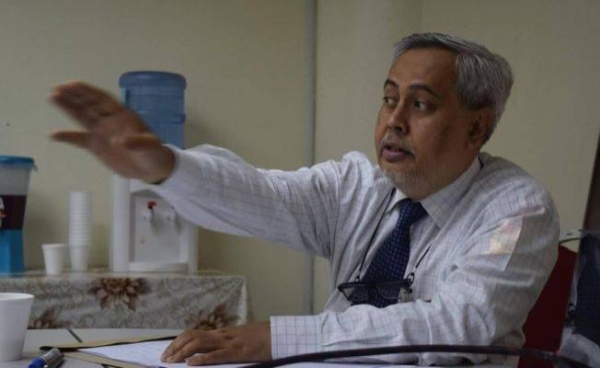
Climate change has led to tremendous effects on the yield of rice in the country. The Malaysian Agricultural Research and Development Institute’s (MARDI) Climate Change Programme Deputy Director Mohammad Hariz Abdul Rahman, says the global temperature rise by 1.5 degrees Celsius is expected to reduce rice yield in Malaysia by 30-percent.
In an interview with the BFM radio recently, Hariz said [ihc-hide-content ihc_mb_type=”show” ihc_mb_who=”2,3,5″ ihc_mb_template=”1″ ]that Malaysia is currently experiencing weakened rice production especially in the east coast.
The key to finding solutions is in the understanding of the problem. In efforts to address climate change, what instantly comes to mind is often measures to combat the rise in temperature.
However, climate change is not entirely about the rise in temperature, said Hariz. It is a dynamic process and is more accurately linked to the change in weather patterns.
“Sometimes, the temperature may remain the same but changes in weather patterns such as prolonged dry spell which can last up to four months, reduced amount of precipitation (rain), El-nino, droughts and flooding are observed. These changes affect the rice productivity in our country.”
“For instance, from 1970 to 2000, an increase of approximately 0.6 to 1.4 degrees Celsius in temperature caused changes in weather patterns”, Hariz added.
In Malaysia, rice is cultivated in two different agricultural settings – the granary infrastructure (structured irrigation system with dams) which accounts for about 80 percent of the rice fields in Malaysia and the remaining 20 percent consisting of the non-granary (rain-fed) infrastructures. Malaysia relies primarily on its key granary areas for its supply of paddy. The average grain yields from non-granary areas are about 2.6 tonnes per hectare while for granary areas it is at 4.8 tonnes per hectare.
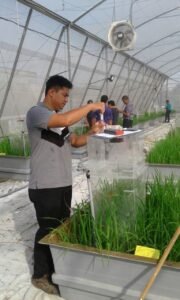
Rice plants grown at the non-granary fields are more prone to water shortage as a result of climate change because these areas rely solely on water supply from rivers and precipitation (rain) during cultivation.
Prolonged dry spell affects rice yields in the non-granary fields particularly in the remote areas where the rivers dry up and the plants receive low amounts of precipitation. On the other hand, the government intervenes by supplying water pumps to overcome water scarcity in granary fields.
Hariz said in a projection study carried out by MARDI, it has been observed that an increase in temperature of 1 to 2 degrees Celsius reduces rice yields by about four to five tonnes (20 percent of the total yield) in the granary fields. Besides prolonged dry spells, MARDI’s study also suggested that haze contributes to about 20 percent loss in the granary rice areas.
These reduce in rice yield affects the self-sufficiency level of rice production in Malaysia. According to a report by the Khazanah Research Institute – The Status of Paddy and Rice Industry in Malaysia, Malaysia’s rice self-sufficiency level hovers between 60 to 70 percent since the 2000. Self-sufficiency level can be simply explained as the ability of a nation to produce satisfying amounts of basic needs, in this context rice, without the need of outside help.
Malaysia imports rice from neighbouring countries such as Vietnam and Thailand to meet the nation’s rice consumption.
The most critical part of rice cultivation
Rice cultivation season is often divided into two – the main season being between September to January and the off season, normally the drier season which is between the months of March to August. However, rice cultivation in Malaysia can be described as an all year round cycle as the cultivation periods differ by a couple of weeks from area to area.
In Malaysia, rice cultivation consists of three main crop stages – vegetative, reproductive and ripening lasting for about 90 to 150 days till the grains are ready to be harvested.
“With the increase in global temperature, the temperature in Malaysia fluctuates between 27 to 32 degrees Celsius which is still below the threshold level. Therefore, MARDI’s stimulation studies under the Eleventh Malaysia Plan focuses on effects of water scarcity on rice growth”, said Hariz.
Hariz explained that the most critical part in the rice growth is its reproductive stage. MARDI’s stimulation studies which will be completed by end of 2020 projected that prolonged dry spell or water scarcity during the reproductive stage would affect rice pollen viability, hence causing reduction in rice yield.
The Eleventh Malaysia Plan (RMK11)

Under the Eleventh Malaysia Plan, MARDI has three stages of study for rice which consist of the short, mid and long term planning.
- Short-term (one to two years): Focuses on current rice varieties and limitation of water. Studies on the effects of water scarcity on rice growth shows that the current rice varieties can survive when the field is flooded at 1cm height of saturated water.
- Mid-term (three to five years): Studies focus on screening of local rice accessions for drought tolerant genes. Data shows the current speciality rice variety (MRQ) developed by MARDI has drought tolerant genes.
- Long-term (five to ten years): Studies focus on the development of rice varieties with drought tolerant genes using high yielding rice and speciality rice variety with drought tolerant genes by applying marker-assisted breeding techniques.
Green House Gases (GHGs) from rice fields
The normal rice planting process require flooding of the rice field up to 7 cm throughout the three growth stages to supress the growth of weeds and reduce competition between the rice plants and weeds for improved rice yield.
Rice fields are a source of the GHGs which are large contributors of climate change. The GHGs from rice fields includes carbon dioxide, methane and nitrous oxide. Anaerobic soil conditions under flooded rice fields produce methane gases – one of the most significant GHGs.

According to Hariz, rice is cultivated on 300, 000 hectares per year. It is considered to be large contributors of methane gas with it emission factor of 1.3kg methane gases emitted per hectare of rice field.
Mitigation approaches towards reduction of GHGs emission
Alternate wetting and drying (AWD) approach is a controlled and intermittent irrigation technique applied to rice cultivated areas to maintain continuous standing water in the crop field. A periodic drying and re-flooding of rice fields is carried out following the initial flooding in which the fields are allowed to dry for a few days before being re-flooded. This approach reduces water demand for irrigation and lowers GHGs emission without stressing the plants and affecting the crop yields.
Rice fields in Vietnam receive their water supply from the Mekong River. This enables Vietnam to apply the AWD technique in their agricultural fields which significantly reduces emission of GHGs especially methane.
However, due to the geographical differences between the agricultural settings in Malaysia and Vietnam, AWD technique cannot be applied in Malaysia.
“One of the ways to reduce methane emission is proper management of rice straws. Currently, 10 to 20 percent of straws is being burnt while the rest integrate back into the soil. In Malaysia, we are currently formulating composition of substrates and microbes to help improve the decomposition of rice straws which can help reduce methane emission”, said Hariz.
Measures for a better yield production
The effects of climate change also need to be considered along with other evolving factors that affect agricultural production such as effective farm management practices which include proper pest and weed management and improved technology.
By the year 2040, the global temperature would potentially increase by 1.5 degrees Celsius, said Hariz. MARDI hopes to successfully develop a drought tolerant rice variety under the Twelfth Malaysia Plan with hope that the self-sufficiency level of Malaysia’s rice production will not be affected by climate change. [/ihc-hide-content]