TANGKAK — well known as the Textile Town of Malaysia – owing to the scores of textile merchants and retailers selling fabrics and other cloth products will soon another moniker, perhaps as the country’s Kacip Fatimah Hub.
Kacip Fatimah (Labisia pumila), a herb said to be the ideal tonic for women’s health and wellness is all set to elevate the social mobility of rural communities and boost the growth of the herbal industry in the district thanks to the Malaysian Bioeconomy Development Corporation (Bioeconomy Corporation).
Recently the Ministry of Science, Technology and Innovation (Mosti) Social Innovation (MSI) project for the planting of Kacip Fatimah to Persatuan Peniaga Kecil Kampung Sagil Tangkak Johor was officially handed over to the association (Persatuan).
The Bioeconomy Corporation, implemented the project under the Bioeconomy Community Development Programme (BCDP) thanks to the MSI Fund that was approved by Mosti.
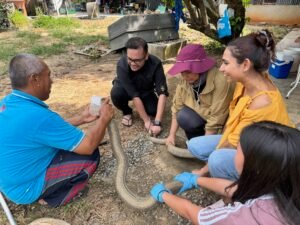
The fund was used to cover the cost of training ten members of the Persatuan, in addition to the construction of a shade house and a cutting house, purchase of equipment, as well as purchase of 6,000 high-yielding breeds of Kacip Fatimah. The project, which ran from Aug 1 last year to April 30 this year, also enabled members of the Persatuan to acquire the skills to mass produce Kacip Fatimah through vegetative propagation by cutting method.

Minister of Mosti, Datuk Seri Panglima Wilfred Madius Tangau who officiated the handover, said the project directly benefits the local community as well as the local health products industry thanks to a contract farming and buy-back guarantee agreement between the Persatuan and Bio-alpha East Coast Agro Sdn Bhd, a subsidiary of Bioalpha Holdings Berhad that produces various pre-mium herbal products.
“Members of the Persatuan contribute significantly to the local herbal industry by providing Bio-alpha with a consistent supply of high quality Kacip Fatimah, which the company will use to create health supplements and other health-based products.
“This is expected to create more jobs, generate additional revenue and increase social mobility in the local community especially since Kampung Sagil has the potential to become a unique tourist attraction due to its burgeoning herbal region and close proximity to Gunung Ledang.
“This can transform Malaysia into a globally recognised producer of Kacip Fatimah, while empowering the rural communities to sustain economic wealth,” said the minister.
He added that in the long term, the project will be expanded to involve more members of the Persatuan, including those from villages nearby.
Acting Chief Executive Officer of Bioeconomy Corporation, Tuan Syed Agil Syed Hashim hopes the Kacip Fatimah project will raise awareness among the public and private sectors on the opportunities and benefits of BCDP, particularly its impact on rural development and bio economy growth.
“BCDP can further develop Malaysia’s bioeconomy by link-ing the communities and industry players through technology transfer, besides improving the living standards and income of the rural communities.
“For 2017, we are targeting approximately 600 participants from all over Malaysia to take part in BCDP, which is expected to bring positive impact to about 2,700 lives.
“To achieve this, we intend to provide more opportunities for the communities to engage in BCDP so the programme can be carried out throughout the country in a larger scale,” he said.
As of May 2017, 34 projects involving over 1,900 participants have been implemented under BCDP in various stages. The projects are expected to have an impact on more than 8,900 lives.