A team of researchers at Princeton has discovered a new method to control bacterial growth through special coating surfaces that can instruct or prevent bacterial growth.
This new technology adopts the natural concept of bacterial growth – a process called quorum sensing whereby microbes release biomolecules that can stop or trigger their growth.
Manipulation of bacterial quorum sensing depends on the use of the bacterial themselves.
In a hospital where sanitation is of utmost importance, bacterial growth is inhibited by surface coating called biofilms on hospital equipment that leaves germs vulnerable to disinfectant cleaning products.
On the other hand, in waste water treatment, industrial equipment are coated to enhance the bacterial growth.

Minyoung Kevin Kim (pix), co-lead author and graduate student in the labs of biology professor Bonnie Bassler and engineering professor Howard Stone, both senior authors of the paper said: “Our research raises the exciting, and now plausible possibility that surfaces decorated with quorum sensing-modulating molecules could have anti-infective or pro-growth properties,”.
Aishan Zhao, co-lead author of the paper and a graduate student in the lab of Professor Tom Muir, also an author of the paper added that “While we still have a lot of research left to do, identifying a quorum-sensing molecule that we can tether to a surface, as we have done in this study, could be an ideal strategy for dispersing biofilms”.
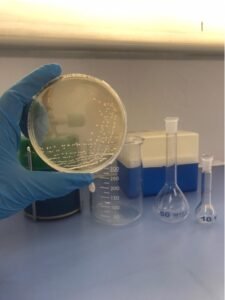
Kim and Zhou conducted their experiments on Staphylococcus aureus or staph that caused severe infections in hospital patients.
It can also develop resistance towards antibiotics making it as number one pathogen that is worth combating.
Previous researches showed that secretion of a molecule named auto-inducing peptides (AIP) caused staph cells to bind to the receptor of neighbouring staph cells in a colony, enhancing their ability to infect adjacent cells causing sickness.
The Princeton team created surface studded with synthetic derivative of AIP, namely TrAIP-II that can shut down the ability of staph to infect neighbouring cells in a colony.
This is done through click chemistry technique that efficiently link small molecules unit that made-up the bigger molecules.
TrAIP-II molecules were attached to surfaces including glass, plastic and metal.
It was found through fluorescent method that TrAIP-II coated sur-face prevented staph bacteria from producing toxins.
The coatings’ ability to remain attach to surface was tested by exposing them to real world environmental stress like plasma from human blood which would be relevant in implanted medical devices in a patient.
It was found out that the coating still worked in the presence of plasma.