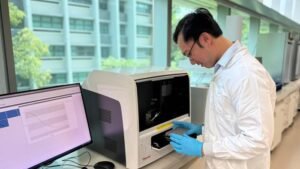
SINGAPORE: Researchers from the Disruptive & Sustainable Technologies for Agricultural Precision (DiSTAP) interdisciplinary research group (IRG) of Singapore-MIT Alliance for Research and Technology (SMART), MIT’s research enterprise in Singapore, in collaboration with Temasek Life Sciences Laboratory (TLL) and Massachusetts Institute of Technology (MIT), have developed a groundbreaking near-infrared (NIR) fluorescent nanosensor capable of simultaneously detecting and differentiating between iron forms – Fe(II) and Fe(III) – in living plants.
It is the first-of-its-kind innovation that enables real-time, non-destructive iron tracking within plant tissues across different plant species, optimising plant nutrient management, reducing fertiliser waste, and improving crop health. The new nanosensor also has potential applications beyond agriculture, in environmental monitoring, food safety, and health sciences, particularly in studying iron metabolism, iron deficiency, iron-related diseases in humans and animals.
Iron is crucial for plant health, supporting photosynthesis, respiration, and enzyme function. It primarily exists in two forms: Fe(II), which is readily available for plants to absorb and use, and Fe(III), which must first be converted into Fe(II) before plants can utilise it effectively. Traditional methods only measure total iron, missing the distinction between these forms – a key factor in plant nutrition. Distinguishing between Fe(II) and Fe(III) provides insights into iron uptake efficiency, helps diagnose deficiencies or toxicities.
This nanosensor developed by SMART researchers enables real-time, non-destructive monitoring of iron uptake, transport, and changes between its different forms, such as Fe(II) and Fe(III) – providing precise and detailed observations of iron dynamics.
This new technology enables the diagnosis of deficiencies and optimisation of fertilisation strategies.

This capability enhances our understanding of iron dynamics in various ecological settings, providing comprehensive insights into plant health and nutrient management.
“Iron is essential for plant growth and development, but monitoring its levels in plants has been a challenge. This breakthrough sensor is the first of its kind to detect both Fe(II) and Fe(III) in living plants with real-time, high-resolution imaging.
With this technology, we can ensure plants receive the right amount of iron, improving crop health and agricultural sustainability,” said Dr Duc Thinh Khong, DiSTAP research scientist and co-lead author of the paper.
“In enabling non-destructive real-time tracking of iron speciation in plants, this sensor opens new avenues for understanding plant iron metabolism and the implications of different iron variations for plants. Such knowledge will help guide the development of tailored management approaches to improve crop yield and more cost-effective soil fertilisation strategies,” said Dr Grace Tan, TLL Research Scientist and co-lead author of the paper.
The CoPhMoRe technique was used to develop highly selective fluorescent responses, allowing precise detection of iron oxidation states. The NIR fluorescence of SWNTs offers superior sensitivity, selectivity, and tissue transparency while minimising interference.
“This set of sensors gives us access to an important type of signalling in plants, and a critical nutrient necessary for plants to make chlorophyll. This new tool will not just help farmers to detect nutrient deficiency but also give access to certain messages within the plant. It expands our ability to understand the plant response to its growth environment,” said Professor Michael Strano, DiSTAP Co-Lead Principal Investigator, Carbon P. Dubbs Professor of Chemical Engineering at MIT, and co-corresponding author of the paper.
Beyond agriculture, this nanosensor holds promise for environmental monitoring, food safety, and health sciences, particularly in studying iron metabolism, iron deficiency, and iron-related diseases in humans and animals.