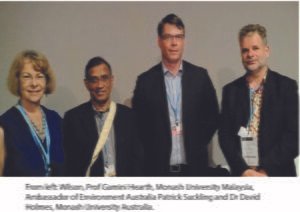
ROBYN WILSON was a delegate representing Monash University Malaysia at the COP22 (Conference of Parties – UN Climate Change Conference) hosted at Marrakech, Morocco recently. In this piece she reflects on the sights, sounds and the social arithematic that made it happen.
I WAS one of eight delegates selected to represent Monash University Malaysia at COP22 (Conference of Parties) – conference on climate change in Marrakech. This was an amazing location and COP22 was an extraordinary experience. This COP was conducted on the grounds of Bab Ighli, the former entrance to Marrakech. The tents where the activities took place were erected specially for the event and covered several hectares.
On The Ground
There were two main areas, the Blue Zone (pass only) where the negotiations, press conferences and side events were conducted and the Green Zone which allowed free entry for the public). The Green Zone was the centre of meetings of indigenous groups, talks by iCARDA, UNDPP representatives, displays by companies involved in renewable energy and hydrology and others, as well as displays and stalls by cooperatives selling argon and olive oil products, hand-woven bags and bead work.
Busy Blue Zone

The Blue Zone was extensive. It consisted of a central paved lane bordered by bare-strips planted with desert plants that lead to large white tents housing six or more countries each with a booth, lounge for functions and a presentation room.
Also off the central lane were the tents for meeting rooms (approximately 25), press conferences, information and registration centre, and two restaurant areas.
John Kerry in a Flurry
It was along this lane that you literally bumped into the US Secretary of State (John Kerry), ambassadors, ministers and other delegates all rushing in different directions to their respective meetings. It was a real buzz of activity. The dress code was mainly formal, black suits, but the African women were resplendent in their brightly coloured and patterned dresses. Each night outside the COP grounds several different African dance groups performed as delegates passed through on their way to evening talks and functions.
Support for Paris Agreement
COP22 followed strong support for the Paris Agreement set by COP21 in Paris in 2015 with 110 countries as signatories; Australia signed the agreement in the first week of the COP22 meeting. This led to a positive feeling at the meeting and according to individuals involved in negotiations there was less tension and shorter evening sessions then that experienced in Paris.
Dynamic Declaration
On the last day of the conference 45 of the countries most vulnerable to climate change signed the Marrakech Declaration. There were a couple of impromptu protests during the COP, one led by the youth representatives, contesting the 2oC target, and pushing for a maximum 1.5oC increase. Let’s hope they can build on this momentum and can carry this off for the benefit of mankind and life on the planet. There was an impressive group of young people, both as negotiators and observers, many of whom I met at the Australian and New Zealand meet-the-ministers evening events.
Jitters Over Donald Trump
This COP coincided with the elections in the USA. In the second week, following the results of the USA elections – Donald Trump as president – delegates were trying to come to terms with the outcome and what it would mean for negotiations and a collective effort to halt climate change. Kerry gave a presentation, his final as the US Secretary of State, summing up his experience from recent trips to the far corners of the planet talking to scientists about their interpretations of climate change based on real data; the general consensus, as evidenced over the last decade, was it happening much faster than predictions.
CO2 Dips
Although we have seen an increase in catastrophic weather events in the past decade there has been a leveling off of CO2 emissions over the last three years. This was attributed to efforts by China and their move towards renewables with a 0.7% reduction in their emissions in 2015. However this should not be interpreted as a reprieve from climate change as there is ample evidence from aseasonal events around the world that climate change is occurring at a faster rate than most governments are planning for.
Pushing the Private Sector
It was identified during many sessions that the private sector need to step up in their response to climate change and that we cannot rely on the governments alone. There was a push for the private sector to adopt new initiatives in addressing climate change and it was acknowledged that this was gaining momentum and becoming evident in the market.
Daunting Task
Although the task ahead is daunting, the enhanced awareness of the urgency for all nations to act, for the private sector to step-up and a far greater need to work together, left you with a feeling of optimism. However, we need greater carbon cuts and a target of 1.5oC increase if we are to prevent irreversible biodiversity loss and a massive increase in unsustainable agricultural land.
NOTE: Wilson is senior lecturer at Monash University Malaysia. Her research interests lie in the areas of tropical ecology, human impacts on wildlife, impact of climate change and human impacts (landscape change) on wildlife.