SINCE recently, several nations have been battling the dengue menace using the Wolbachia-infused mosquitoes with remarkable success.
Malaysia has now joined this league of nations with a soon-to-be launched pilot project using these special mosquitoes to fight dengue.
The notorious Aedes aegypti which spreads the dengue and other viruses is reported to have killed hundreds and thousands of people globally over several decades. Conventional methods in eradicating this species has only been minimally successful.
Mosquitoes infused with the Wolbachia bacterium seem to be the better option as experienced by some countries.
What are Wolbachia mosquitoes?

According to the “Eliminate Dengue” website, Wolbachia is a common bacterium that is present in some 60% of all insects, including some mosquitoes, but it is not found in the Aedes aegypti. Wolbachia only gained popularity in the 1970s, when scientists found that it could prevent mosquito eggs from hatching. Twenty years later, scientists discovered that certain strains of Wolbachia have the ability to reduce the life span of insects, which highlights its prominent role in controlling insect-borne diseases such as dengue.
This has encouraged researchers to find a way to stop mosquitoes from spreading human diseases. The challenge, however, was to get Wolbachia to infect Aedes aegypti.
Creating the Wolbachia mosquitoes
“Imagine taking a knitting needle and poking it into a balloon. Next, you have to remove the needle without popping the balloon. That pretty well sums up the process of infecting mosquito eggs with the Wolbachia bacterium,” says Scott O’Neill of Monash University, Australia.
According to O’Neill, head of the Eliminate Dengue research programme this technique called “microinjection”,involves the infusion of Wolbachia bacterium from other insects directly into the mosquito eggs. O’Neill and team only succeeded after multiple trials with thousands of eggs.
However, the hurdle did not end there. Scientists found that the bacteria were not accustomed to thrive in Aedes aegypti and disappeared after a few generation of mosquito breeding. So, instead of directly infecting the bacteria into the eggs, they were first grown in mosquito cell lines. After more than a decade-long effort, Wolbachia was successfully passed down and survived 13 generations. This enabled the bacteria to subsequently spread on their own.
Wolbachia mosquitoes vs wild Aedes mosquitoes
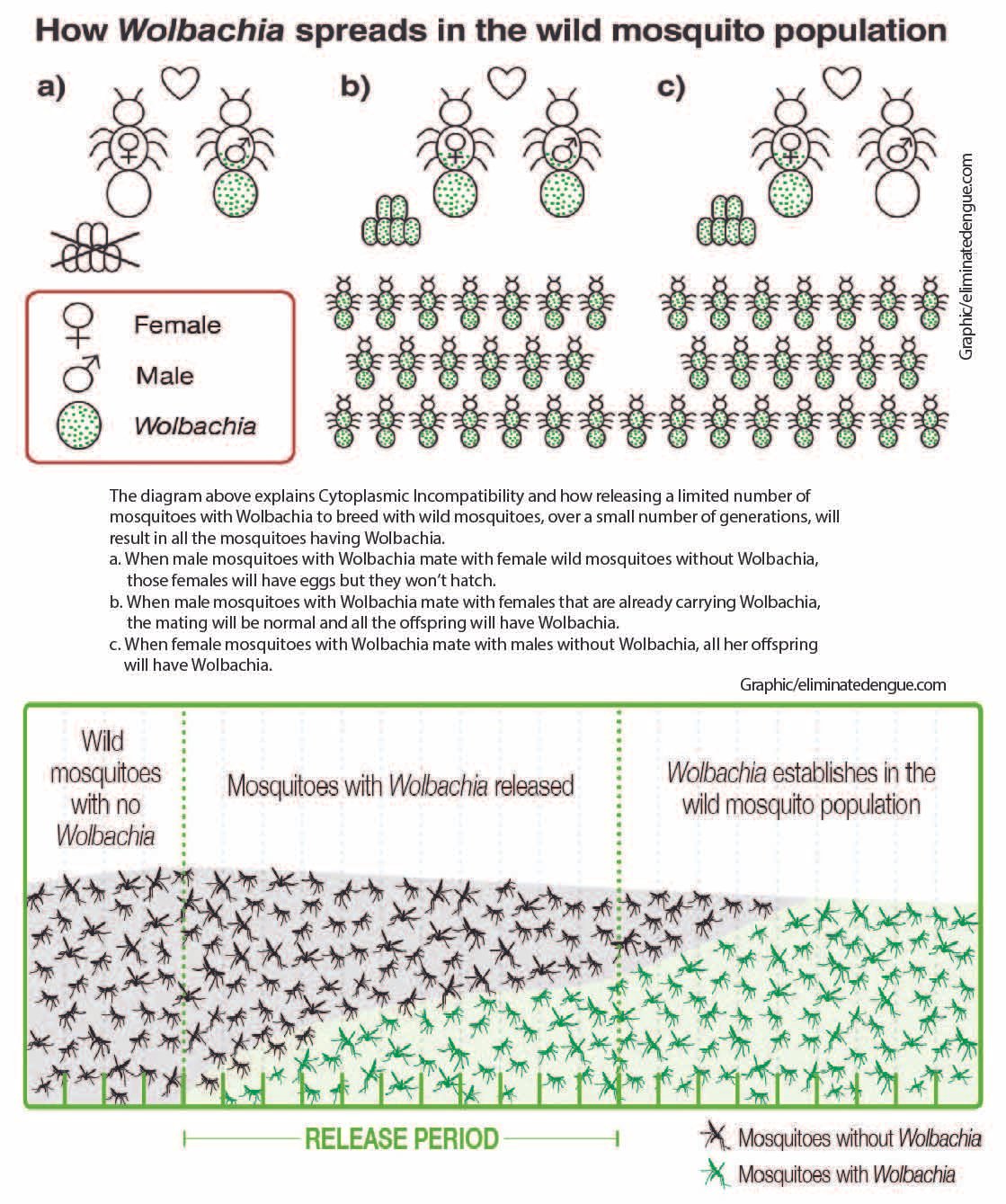
Wolbachia-infused mosquitoes stopped the development and replication of dengue viruses, preventingtransmission of these viruses to humans. By allowing these mosquitoes to freely breed with the wild-type, after a few generations almost all mosquitoes in a population will carry the bacteria.
Field outcome of Wolbachia mosquitoes
Releasing Wolbachia-infused mosquitoes into the wild requires community concerns and approval by officials. Research has shown that Wolbachia is not harmful and it does not infect humans because the size of the bacteria is too large to travel through the salivary ducts of mosquitoes and into the human bloodstream. Wolbachia also poses no adverse threat on the environment, including other insects and animals.
The field study in Australia commenced in 2011, when the first Wolbachia mosquito was released in the neighbourhoods of Cairns. According to Nature, within 14 weeks, Wolbachia had spread to more than 90% of the local Aedes aegypti population in that locale. This success has led to the collaboration of the Eliminate Dengue research group with local universities and government bodies to conduct trials in Brazil, Colombia, Vietnam, Indonesia and India.
A previous effort in battling dengue via the release of Toxorhynchites (Toxo) mosquitoes resulted in limited success due to environmental conditions. This programme, however, is still ongoing and is being monitored by the council and health authorities. Also called the ‘elephant mosquitoes’, Toxo mosquitoes are generally larger than Aedes mosquitoes. They feed on the larvae of other mosquitoes, including those of Aedes. Toxo mosquitoes are harmless to human as their diets do not include blood, but only nectar of plants and mosquito larva.
On a similar note, Malaysia was one of the first few countries to conduct field trials on GM mosquitoes where sterile male Aedes were developed and released into the environment. These male mosquitoes breed with the normal female mosquitoes and their progenies do not survive adulthood. The technology was from Oxitec, a British company based in Oxford with IMR as the local research collaborator. The technique yielded positive results in Brazil that saw a reduction in the Aedes population and is currently commercially employed, but the project was halted in Malaysia for various reasons made vaguely known to the public.