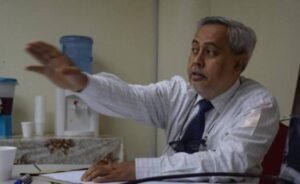
Rob Varley, Britain’s top weather man holds court at the Met Office in Exeter as the Chief Executive. He started his career as a weather forecaster, then spent 10 years as trainer of Britain’s weather forecasters and also project-managed the construction of the current Met Office headquarters. In a recent sojourn to Kuala Lumpur, The Petri Dish Editor-in-Chief, MAHALETCHUMY ARUJANAN, caught up with him for a Q & A-styled tete-a-tete.
What does your job entail?
The Met Office is the UK’s national weather and climate service. We work at the forefront of science to enable protection, prosperity and wellbeing. As the Chief Executive (CE), I lead a team of 2,000 people working to deliver this mission.
What education, training and skills are needed to be a meteorologist?
We recruit graduates in mathematics and physical sciences. Our own in-house training programmes then provide the specialist skills needed, depending on the particular role.


How was your career progression till you became UK’s Chief Executive for the Met Office?
I joined the Met Office in 1983 as a graduate trainee. My first job was as a weather forecaster at a regional centre. I then spent ten years in professional training, eventually as the Met Office’s Chief Instructor. This was followed by four years as a project manager, overseeing the construction of a new headquarters for the Met Office in Exeter, SW England. I became a Director in 2007, and CE in 2014.
What is a typical day like for a weatherman who works on the ground?
There are many different roles. For a typical meteorologist like I once was, the twelve-hour shift begins with analysis of a wide range of data to determine the likely conditions. The rest of the shift is spent helping clients make the right decisions given the likely conditions – this could be a pilot choosing a route; the timing of an offshore operation; getting the right foods on the supermarket shelves; or even whether to close the roof on Wimbledon Centre Court.
What your office do affects many people – the fishermen, holiday goers, and ordinary people who live in areas prone to extreme weather conditions like flooding, storms, hurricane etc. How do you manage the responsibility?
Yes our work can literally mean the difference between life and death. So it’s really important at all times to act in a thoroughly professional way. As long as all of our people are fully equipped to do their jobs I can be confident that we will not let our customers down. That’s why training and development are so important.
Is there anything you dislike about your job?
Being the CE means that I am always accountable for everything the organisation does. That’s a very heavy, constant responsibility, every day of the year. Fortunately I have a great team, so when I am taking time off I can be confident the Met Office is in good hands.
What are the top challenges in your field, especially with climate change?
We work on all timescales – monitoring the environment minute-by-minute and projecting possible future conditions 100 years into the future. To do this, we operate one of the world’s most powerful supercomputers. After 50+ years of progress in improving accuracy and detail, we now need to develop a completely new way to code our forecast models that will work efficiently with the next generation of supercomputers. This is the biggest change in forecasting in my career, and will take ten years of multinational collaboration to achieve. Meanwhile, climate risk is increasing all the time, and our science continues to advance. The key challenge here is turning highly complex science into actionable advice to help decision-makers mitigate the risks.
Are there international collaborations, trainings or any other initiatives between countries in this field? Is the Met Office involved in any?
Meteorology is one of the most globally inter-connected fields. Every country in the world collaborates to set standards, share data in real time and to progress the science. The Met Office has partnerships with many countries, and has just signed an agreement with the Malaysian Ministry of Science, Technology and Innovation to work together on weather and climate science and services.
Tell us about your involvement in professional international bodies.
I am the UK’s Permanent Representative at the United Nations World Meteorological Organisation and sit on its Executive Council; I am President of Eumetnet (a collaboration of 31 European national weather services); and I am the UK’s representative on the Councils of Eumetsat and the European Centre for Medium-range Weather Forecasts.
Eumetnet is a grouping of 31 European National Meteorological Services that provides a framework to organise co-operative programmes between its Members in the various fields of basic meteorological activities. These activities include observing systems, data processing, basic forecasting products, research and development and training.
Eumetsat is the European Organisation for the Exploitation of Meteorological Satellites , an intergovernmental organisation founded in 1986. Its purpose is to supply weather and climate-related satellite data, images and products – 24 hours a day, 365 days a year – to the National Meteorological Services of its Member and Cooperating States in Europe, and other users worldwide.

Did you have any inclination towards weather and related stuff when you were a child?
My father was a meteorological forecaster, so he first got me interested in this field. And I have always had a passion for the outdoors – hill walking, cycling, exploring – where inevitably the weather is a major factor, especially in Britain!
Share with us an experience that you will treasure in your career or that is related to your personal life.
The most satisfying aspect of my job has been developing people and seeing their careers flourish. During my time at the Met Office College I trained over 250 forecasters, many of whom are still working in the field. It has been immensely satisfying to see them put their skills to good use and develop great careers. And the one thing that I have worked on that I hope will outlive me was the headquarters building. It was a once-in-a-lifetime project, and it’s still a great place to work and continues to impress all who visit.
How do your training, experience and career make you see the world differently than others?
My understanding of the fragility and interconnectedness of our global ecosystems drives a deep concern about the potential impact on future generations – our science is helping inform policy which I hope will help mitigate the risks. And my international work has enabled me to develop friendships all over the world, giving me a global perspective on life, and a real appreciation for the benefits of diversity in all its forms.
What is your advice to young people who aspire to build a career in this field?
Three things: firstly, thirst after knowledge, skills and understanding. Education is precious so seize every opportunity. Specifically in my field maths and physical sciences are the key disciplines.
Secondly, seek out and listen to wise people. Take advice from those you trust and respect. At certain points in my career such advice has been pivotal.
Finally, don’t be constrained by the past – don’t be afraid to challenge the status quo. We live in rapidly changing times, and the problems we all face need fresh thinking and innovative solutions.