Sarawak Pioneers in Sustainable Aviation Fuel (SAF) Production
Sustainable Aviation Fuel (SAF) can reduce carbon emissions by 80 per cent. By mid-June in 2022, SAF powered some 450,000 flights. For example, the popular low-cost carrier, AirAsia, is currently exploring options to introduce SAF into its fuel mix before 2025.
However, last year, sustainable aviation fuel (SAF) usage reached only 600 million litres or 0.5MT. This is double the amount produced in 2022 but still amounts to only 0.2 per cent of all aviation fuel produced globally. A limited production volume means SAF will be much more expensive than conventional jet fuel, as there will be fewer takers for this environmentally-friendly alternative due to cost factors.
But there are good reasons to draw cheer for the Borneo state of Sarawak. The state is now gearing up to produce 100,000 barrels of SAF per day by 2030. Sarawak’s plan to venture into producing SAF was declared in September last year by Deputy State Secretary Datuk Dr. Muhammad Abdullah Zaidel.
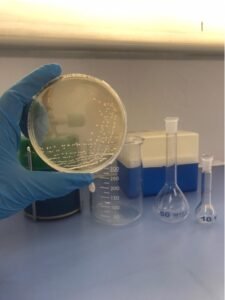
The announcement is also timely as Sarawak’s proposed state-owned airline is expected to be up and running by the second quarter of this year – and its planes will most likely be powered by the state’s home-made SAF eventually. Muhammad Abdullah said that microalgae grown in waters mixed with carbon dioxide would be used to produce SAF, which is increasingly adopted by global airlines.

He said: “The use of carbon dioxide for the cultivation of microalgae comes at a time when Sarawak is also exploring more business opportunities in the multi-billion-dollar carbon capture, utilization, and storage (CCUS) industry. We have identified 10,000 acres of land in Bintulu for algae plantation. About 1,000 acres of algae can produce 10,000 barrels of SAF a day, so with 10,000 acres, we can produce 100,000 barrels by 2030,” he was quoted as saying by local media.
‘First Mover Advantage’ in Green Economy
Speaking to The Petri Dish, Universiti Malaysia Sarawak (UNIMAS) Honorary Professor Datuk Dr. Madeline Berma said Sarawak’s first industrial microalgae production, the CHITOSE Carbon Capture Central Sarawak (C4 Sarawak), was officially launched in May 2023.
“It marked a significant milestone towards achieving a sustainable green economy for Sarawak, aligned to its ‘Green Energy Agenda.’ C4 Sarawak and the research it will conduct potentially lay the foundation for the development of a new economy within the state and will create significant economic value for the people while ensuring sustainability,” she said.
Madeline pointed out that SAF is the future economic driver for Sarawak. She said: “Sarawak can benefit from the robust growth in the global SAF market, which is projected to grow from USD1.1 billion in 2023 to USD16.8 billion by 2030.
“The SAF is experiencing rapid economic growth. Given that the International Civil Aviation Organisation has mandated that all aviation companies must use environmentally-friendly fuel by 2027. Regular fuel cannot be used anymore, as it emits carbon which pollutes the air. Sarawak will benefit from the ‘first mover advantage,’ being one of the first states in Malaysia to promote actively the ‘Green Economy’ as a basis for its development.”
SAF: More than a Buzzword
Speaking to The Petri Dish, Dr. Mahaletchumy Arujanan, Executive Director of the Malaysian Biotechnology Information Centre, said: “SAF is no longer a buzzword but a ‘must-do’ to decarbonize the aviation industry.”
Mahaletchumy is a renowned science communicator who is listed among the 100 most influential persons in biotechnology by Scientific-American. She is also the executive director of the Malaysian Biotechnology Information Centre, based in Petaling Jaya.
She said: “It is laudable for Sarawak to be an early start-up and pioneer to venture into this industry, which is potentially new and still requires more research in the area of lipid extraction from the feedstock, finding ways to reduce the cost of harvesting, and improving the drying procedures to make the end product economically viable at the consumer’s end. This is where collaboration between industry and universities will help and lead to more research positions for our PhD graduates. It will certainly be exciting to watch the growth of the SAF industry as well as to appreciate the reduction of the carbon footprint in the aviation industry.”
On another note, Mahaletchumy suggested that SAF can also be extracted from other kinds of feedstock, such as biomass, and this possibility must be explored. She said: “Sarawak has a huge and readily available stock of biomass from its pepper and oil palm plantations, and this fodder could promote the sustainable use of agricultural waste, which would otherwise end up in landfills and contribute to the rise of greenhouse gases.”
“Our planet is endangered and in a crisis. The time is now for us to grab the opportunity to reach for far horizons and to focus on this immediate exigency to heal the world,” she added.