Dr Mohammad Rahim Kamaluddin says it all for criminology. It is a blend of science and the arts. It is multidisciplinary, involving psychology, forensics, pathology, humanities and the social sciences. In this interview with MAHALETCHUMY ARUJANAN, he takes our readers into the how, and why, and what of criminology and speaks of a fruitful and rewarding career path in this very dramatic and demanding profession of a criminologist. He also speaks about his passion for community service.
You are a great mentor for young people in the fields of education, crime prevention and also your love for Tamil language. Tell us about your social activities.
I mainly focus on two tracks – crime prevention and motivational talks. Crime prevention is a part of my expertise and one of the niche areas of criminology. I often get invitations from schools, NGOs, government agencies and universities to deliver talks on crime prevention and crime awareness.
I also love giving motivational talk. Being a former student of Menglembu Tamil School, I think it is my time to contribute to my community. I love to motivate students and make them aware of the impacts and importance of education. I go to the schools with the hope that I can motivate them and every time I will be back with the highest level of satisfaction after looking at positive changes among them. Till now, I have delivered talks to more than 50 schools.
I always bring my PhD scroll and gold medals during motivational talks for my audience to see, touch, and feel. I think the value of both gold medals that I received is more valuable when the students can see, touch and feel.

What is close to your heart beside your professional field? What do you aim to achieve in your social life?
As I mentioned earlier, Tamil schools are very close to my heart. I want to see Tamil school students be successful as others. Besides Tamil schools, I also have a soft spot for students who are from rural areas. I want all of them to be successful. I am very sure one person from each family can change the fate of that particular family with education. I have seen students from very poor background and they don’t even have money to buy school badge or school tie. I want all these kids to study hard and achieve their goals and ambitions.
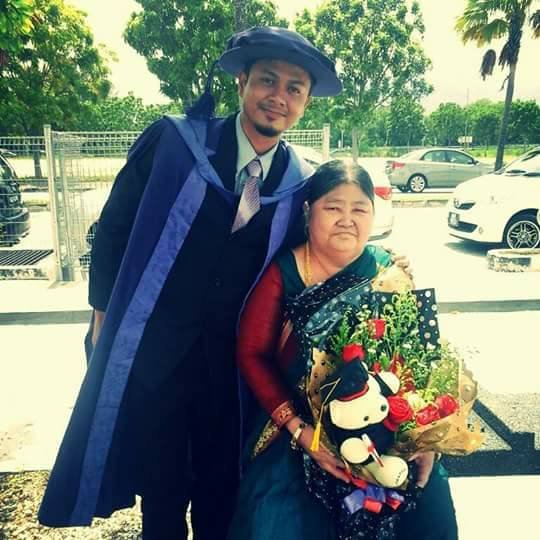
You have been an extraordinary student during your degree programme and PhD studies at Universiti Sains Malaysia. You won the Chancellor’s Gold Medal award, the Royal Education Award from Perlis ruler Sultan Syed Sirajuddin Syed Putra Jamalullail, and a special award for completing your PhD on time. Tell us what motivated you in spite of your humble beginning?
I don’t have any secret recipe for my achievement and in fact, I never aimed for those medals. Not at all. People say if you do things in a right way, you no need to chase recognition but recognition will chase you. Here, I would like to share what I have done and I think that made me get those medals.
First of all, respect and love your parents. You need to get their blessings every day. Secondly, respect your teachers, and lecturers. Always equip yourself with positive vibes and intention. Put adequate hard work and efforts to achieve your goal and most importantly please share your knowledge with others. Finally, be humble always.
What made you choose forensics? Did you have any idea about the field and its prospects before pursuing the degree?
I did not even know the existence of forensic science until I applied for my university. My ambition, goal, dream and vision was to become a medical doctor. I used to add the word ‘Dr’ in front of my name since the age of five. In fact, my whole family and primary school teachers often addressed me as Dr Rahim.
After completing my STPM, I put medical degree course as my first choice. I couldn’t think of any other courses besides medical degree to fill up the other 7 choices. My third brother suggested me to apply forensic science as my fifth choice. He convinced me that forensic science is almost similar as a medical degree. I was very confident that I will get a place in the medical degree course until I checked my UPU result via SMS. It was forensic science. To be honest, I just took less than ten minutes to feel sad and cry. Then, I just wiped my tears and decided to study until PhD and yes, I achieved that on April 25, 2015.
Explain forensics to us for the benefit of the general public and students.
Forensic science simply means the application of science in legal processes/context such as crime. In other words, it is the study of how science can be used to solve legal problems like crimes. It is a multidisciplinary field in which the knowledge and the facts that are used to solve crimes are mostly “borrowed” from other fields such as medical, law, chemistry, physics, biology and much more.
There are so many subfields under Forensic Science. Allow me to name a few, Crime Scene Investigation, Forensic Toxicology, Forensic Medicine, Ballistics and Explosives, Fire Investigation, Criminalistics, Physical Evidence, Biological Evidence, Forensic Entomology, Forensic Anthropology, Forensic Biology, Forensic DNA, Forensic Psychology and Criminology, Forensic Document Investigation and various kinds of forensic chemistry subjects. What I can say is all the subfields are really interesting and beneficial to solve crimes.
For the general public, forensic science is one the fields that they should know, at least, have some basic knowledge. Let me tell one example, once a crime happened (for example burglary), people should know that they shouldn’t enter the site and disturb or touch anything in that crime scene. This is because the evidence can be contaminated and mispositioned, therefore, crucial evidence like fingerprints and other biological samples like hair, body fluids cannot be analysed. The task of crime scene reconstruction will be more difficult.
What are the career prospects for forensics students in Malaysia? What are the areas they could venture into both for career and for post graduate studies?
The majority of the forensic science graduates work in Jabatan Kimia Malaysia, Polis Diraja Malaysia, Jabatan Bomba, hospitals and some work in the private sectors such as insurance companies, private detective agencies, and chemical based industries. I can say the prospect is still good. But bear in mind, the selection is very competitive and tough, therefore the degree alone is not sufficient. You need to excel in other aspects as well, such as personality, soft skills, communication skills, and be socially competent.
One more thing, with a bachelor’s degree alone you cannot expect to become a renowned forensic scientist or expert. You need to go for Masters and PhD. There are so many areas in forensic science which are still unexplored and we are far behind the UK and the US in this area. For instance, we are still lacking of experts in document investigation, forensic biology, forensic anthropology, forensic entomology, fire scene investigation, forensic criminology and psychology and also from other fields.
Many students and graduates these days are not aware of the opportunities in multidisciplinary areas. They think their career and post-graduate studies have to be in the same field as their first degree. What is your advice to them?
The world is moving towards multidisciplinary and my suggestion is be a risk-taker and believe in yourself. When I set out to do PhD in criminology, my lecturers were shocked and contacted me to reconsider my decision. Some of them told me that “you are a scientist, and you shouldn’t go to the other side. It will be a big waste”.
Somehow I managed to convince them and now when I visit my lecturers they will tell me “Dr Rahim, you made the right choice”. My advice to the students out there, don’t be afraid to choose multidisciplinary fields for your postgraduate level. At the same time don’t deviate from your root (bachelor’s degree) as you may lose your expertise.
How did you then choose to pursue criminology and divert into social studies for your PhD?
Criminology is one of the subjects that is being taught along with forensic science together with other related subjects such as forensic psychology and basic psychology. I like all the science subjects under forensic science but I fell in love with criminology. The underlying concept and philosophy of criminology are different with other subfields of forensics.
It is not science and at the same time, it is not an art field. It is in between. It is a blended field of science and arts. I feel criminology is adventurous, abstract in nature, explorative and unique.
My personality could have also triggered me to choose this field. Basically, I am an extrovert. Being a criminologist, you need to be active in delivering crime talks, be a part of the community to fight crime and also need to interview the criminals and explore their mind and their modus operandi.
So, that is the reason why I love criminology more than other subjects. I can say that I scored As for science subjects under forensic science but I scored A with passion and love for criminology.
What are the challenges in your career as forensic criminologist?
There are few challenges that I would like to highlight here. One of them is while doing research among prisoners. While conducting research in a prison setting, you need to obey the rules set by the prison authorities. One of them is you cannot bring in an audio recorder, one of the important tools for an interview. Social scientists use audio recording device while interviewing and later transcribe them. Trust me it is not an easy task.
Another challenge is to obtain valid and honest responses from them. For that, you need to equip yourself with lots of skills to gain their trust. If you failed to gain their trust, they would not disclose the truth. And most of the inmates are illiterate and imagine you need to explain each of the items in the questionnaire to them. Explaining each item will consume at least three to four minutes and the whole session may go up to five hours.
Your job can be quite depressing as well as can be eye-opener that leads us to the reality of life and also things that we take for granted. Can you share with us some stories that touched you so much?
There are hundreds of stories in my mind. Since I became a criminologist, I have met and interviewed various types of offenders – murderers, female criminals, burglars, terrorists, rapists, firearm offenders, juvenile delinquents, thieves and much more. One of the stories that I want to share is when I visited one of the prisons, I met one inmate and he shared how much he is suffering in prison. He told me, “I miss my mum, my wife and my kids. Today is my son’s birthday and I am not sure whether they are celebrating or not”.
Another story that touched my heart was when I visited one juvenile schools, I met a juvenile and he told me that the most memorable moment in his life was when his abusive father bought a packet of Kentucky Fried Chicken and the whole family enjoyed and finished the meal. According to him, that was the only meal that they ate peacefully as the rest of the days were disruptive and violent due to his father’s abusive behaviour towards his mother and him.
You have achieved quite a bit at a very young age. Where do you see yourself in the next ten years? What are your aspirations?
In ten years time, I want to see myself as a successful figure in both social and professional aspects. I dream to establish a foundation or an association that could nurture and uplift Tamil school students and also other poor students.
In terms of professional area, I desire to set up a centre or institution for criminal studies in Malaysia. I want that institution as a CBI or FBI of Malaysia working on crime and criminal studies and act as a referral centre for judges, police officers, lawyers and other criminal justice folks. I want at least ten criminologists specialising in different areas such as victimology, profiling, penology, criminal psychology, criminal psychopathology, criminal policy, crime scene reconstruction – all working in that institution. I know that I am being very ambitious but I think it is possible.
NOTE: Dr Mohammad Rahim Kamaluddin is a senior lecturer and Head of Crime Prevention and Recidivism Research Group Psychology and Human Well-being Research Centre, Faculty of Social Science and Humanities, Universiti Kebangsaan Malaysia. He is also a member of Malaysia Crime Prevention Foundation as well as Crime Against Women and Children Foundation. He also sits on the editorial board of several international and local journals.